
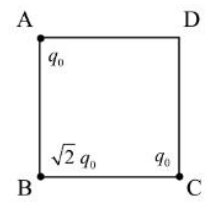
As shown in the figure, three charges are placed at three corners of a square of side \( \sqrt{5} \) cm. If \( q_0 = \sqrt{2} \times 10^{-6}\,\mathrm{C} \), the magnitude of electric field at point D is.
Answer & explanation
Correct answer: option 1
The correct answer is Option (1) → \( 54 \times 10^{6}\,\mathrm{N\,C^{-1}} \)
The field at D is the vector sum of the fields of the three charges (superposition principle). Each positive charge gives a field \( kq/d^{2} \) pointing away from it. Take \( +x \) to the right (from A to D) and \( +y \) upward (from C to D).
Reading the figure: A (charge \( q_0 \)) and C (charge \( q_0 \)) are at distance \( a \) from D, giving fields along \( +x \) and \( +y \); B (charge \( \sqrt{2}\,q_0 \)) is at the diagonal distance \( \sqrt{2}\,a \), giving a field along BD.
\( \displaystyle E_{A} = E_{C} = \frac{k q_0}{a^{2}}, \qquad E_{B} = \frac{k\,\sqrt{2}\,q_0}{(\sqrt{2}\,a)^{2}} = \frac{k q_0}{\sqrt{2}\,a^{2}} \)
The diagonal BD makes \( 45^\circ \) with both axes, so each component of \( E_B \) is
\( \displaystyle E_{B}\cos 45^\circ = \frac{k q_0}{\sqrt{2}\,a^{2}} \times \frac{1}{\sqrt{2}} = \frac{k q_0}{2a^{2}} \)
\( \displaystyle E_{x} = E_{y} = \frac{k q_0}{a^{2}} + \frac{k q_0}{2a^{2}} = \frac{3}{2}\,\frac{k q_0}{a^{2}} \)
\( \displaystyle E = \sqrt{E_x^{2} + E_y^{2}} = \frac{3\sqrt{2}}{2}\,\frac{k q_0}{a^{2}} \)
\( \displaystyle a = \sqrt{5}\,\mathrm{cm} \;\Rightarrow\; a^{2} = 5\,\mathrm{cm^{2}} = 5\times10^{-4}\,\mathrm{m^{2}} \)
\( k = 9\times10^{9}\,\mathrm{N\,m^{2}\,C^{-2}} \)
\( \displaystyle E = \frac{3\sqrt{2}}{2} \times \frac{9\times10^{9} \times \sqrt{2}\times10^{-6}}{5\times10^{-4}} = \frac{3 \times 9\times10^{3}}{5\times10^{-4}}\,\mathrm{N\,C^{-1}} \)
\( \displaystyle E = 5.4\times10^{7}\,\mathrm{N\,C^{-1}} = 54\times10^{6}\,\mathrm{N\,C^{-1}} \)