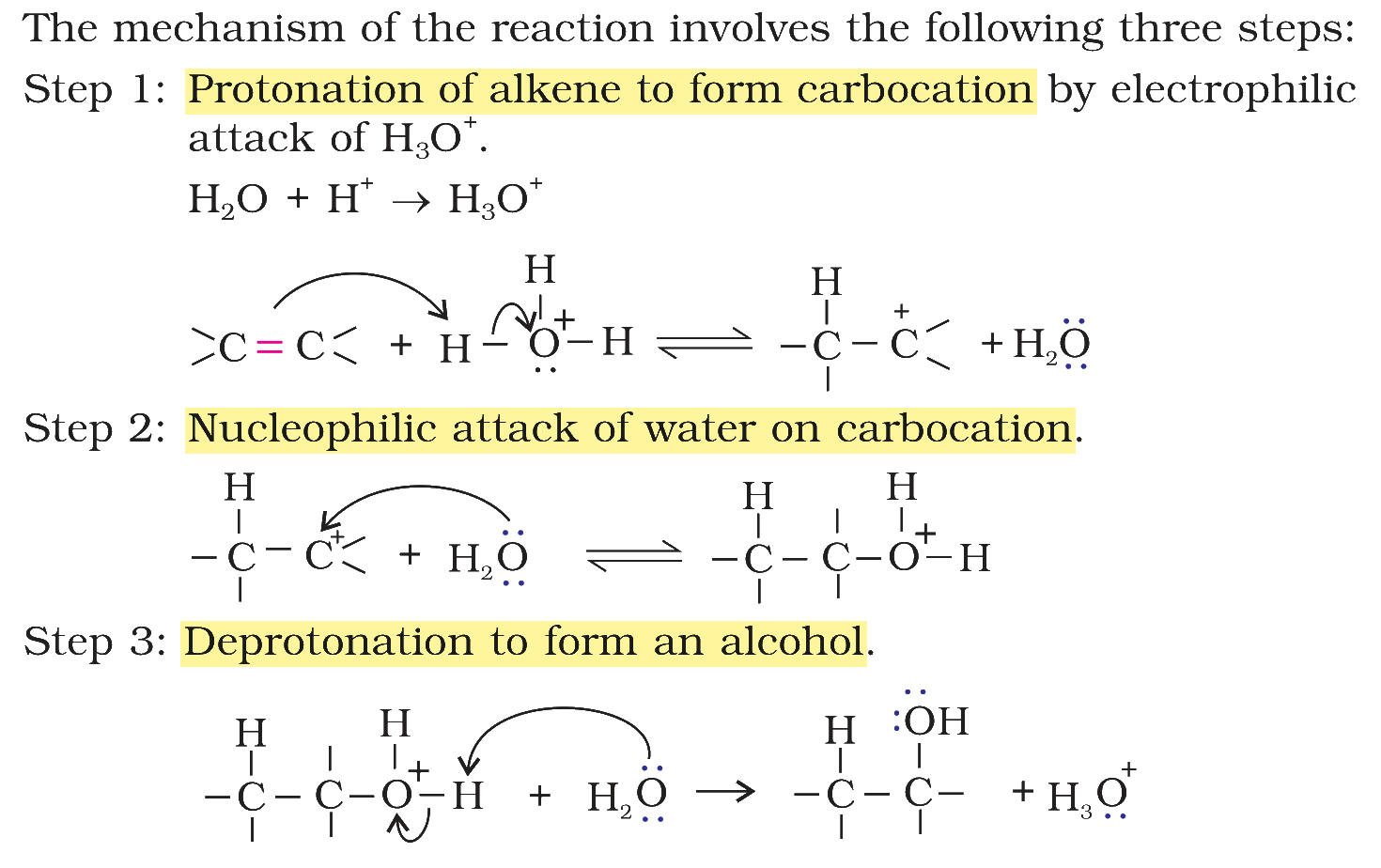
The mechanism of the acid-catalyzed hydration of alkenes involves :
(A) Nucleophilic attack of water on carbocation
(B) deprotonation to form an alcohol
(C) Protonation of water
(D) Protonation of alkene to form carbocation by electrophilic attack of \(H_3O^+\).
Arrange the above steps in the correct order.
Answer & explanation
Correct answer: option 1
The correct answer is Option (1) → (C), (D), (A), (B)
Acid-catalysed hydration of an alkene follows Markovnikov’s rule and takes place in steps. The acid first generates the hydronium ion, which then protonates the alkene:
(C) Protonation of water:
\( \displaystyle \ce{H2O + H+ -> H3O+} \)
(D) Protonation of the alkene by electrophilic attack of \( \ce{H3O^{+}} \), which gives a carbocation:
\( \displaystyle \ce{CH2=CH2 + H3O+ -> CH3-CH2^+ + H2O} \)
(A) Nucleophilic attack of water on the carbocation:
\( \displaystyle \ce{CH3-CH2^+ + H2O -> CH3-CH2-OH2^+} \)
(B) Deprotonation to form the alcohol:
\( \displaystyle \ce{CH3-CH2-OH2^+ + H2O -> CH3-CH2-OH + H3O+} \)
Shortcut: The carbocation must form before water can attack it, and the alcohol appears only at the last step; only Option (1) has D before A and B last.
NCERT (2026-27 edition):
Mechanism