
The C-Br bond in bromobenzene as compared with C-Br bond in ethyl bromide is
Answer & explanation
Correct answer: option 3
The correct answer is Option (3) → Shorter and stronger
Two effects make the C–X bond of a haloarene shorter and stronger than that of a haloalkane.
Hybridisation: in bromobenzene the carbon bonded to bromine is sp2 (33% s-character); in ethyl bromide it is sp3 (25% s-character). An orbital with more s-character holds the bonding electrons closer to the nucleus, so the bond is shorter.
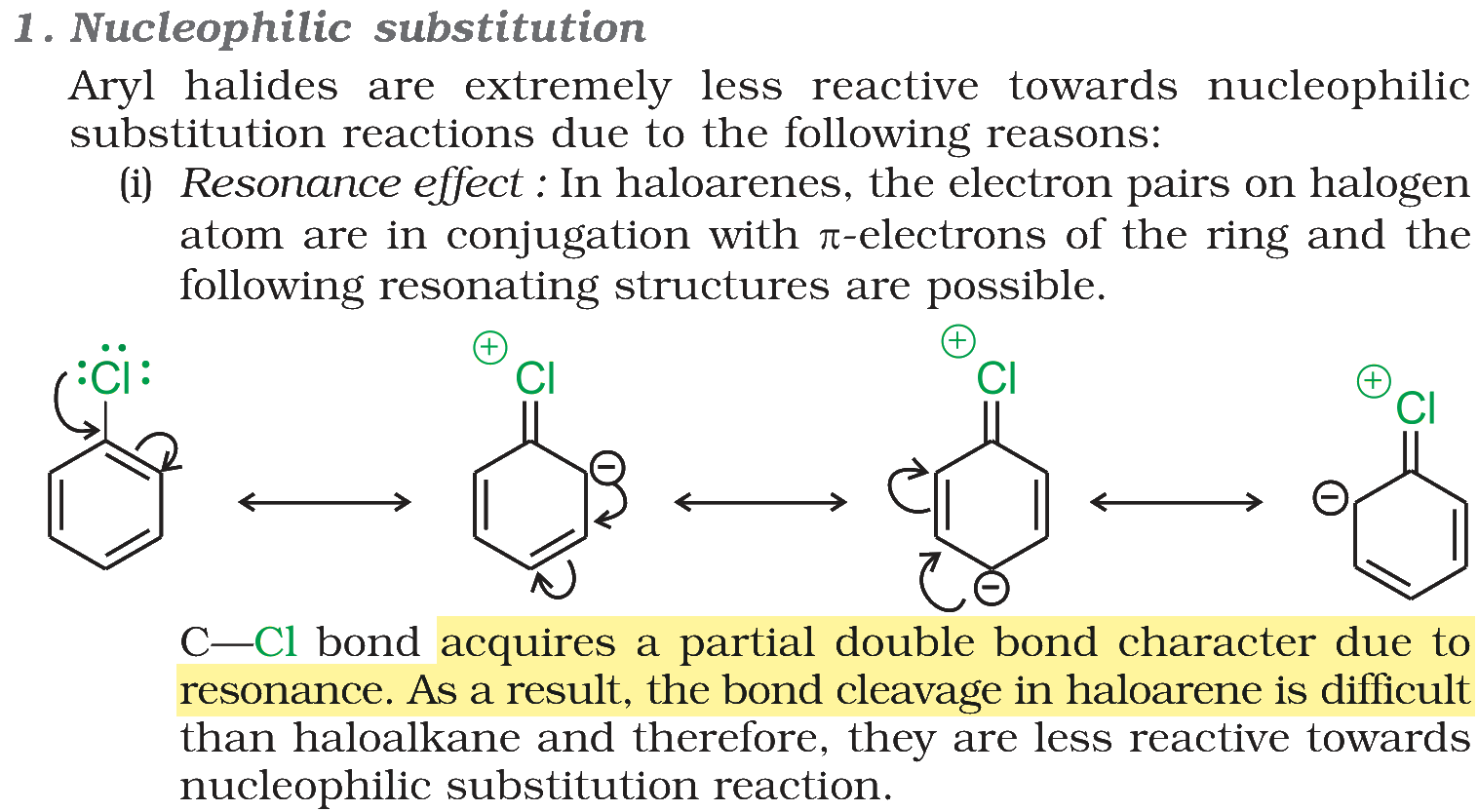
Resonance: a lone pair on bromine is in conjugation with the π-electrons of the ring, so in some resonance structures the C–Br bond is a double bond. The bond therefore has partial double bond character, which shortens it and makes it harder to break.
So the C–Br bond in bromobenzene is shorter and stronger than in ethyl bromide. This is also why haloarenes are much less reactive towards nucleophilic substitution.
Why the other options are incorrect
Option (1) Longer and weaker — Incorrect. This describes the C–Br bond of ethyl bromide compared with bromobenzene, the reverse of what is asked.
Option (2) Shorter and weaker — Incorrect. A shorter bond with partial double bond character is stronger, not weaker.
Option (4) Longer and stronger — Incorrect. Greater s-character and partial double bond character both shorten the bond.
NCERT (2026-27 edition):
Nucleophilic Substitution
“… (ii) Difference in hybridisation of carbon atom in C—X bond: In haloalkane, the carbon atom attached to halogen is sp3 hybridised while in case of haloarene, the carbon atom attached to halogen is sp2-hybridised. The sp2 hybridised carbon with a greater s-character is more electronegative and can hold the electron pair of C—X bond more tightly than sp3-hybridised carbon in haloalkane with less s-character. Thus, C—Cl bond length in haloalkane is 177pm while in haloarene is 169 pm. Since it is difficult to break a shorter bond than a longer bond, therefore, haloarenes are less reactive than haloalkanes towards nucleophilic substitution reaction.”