Aniline can be distinguished from ethanamine by
Answer & explanation
Correct answer: option 3
The correct answer is Option (3) → Nitrous acid test
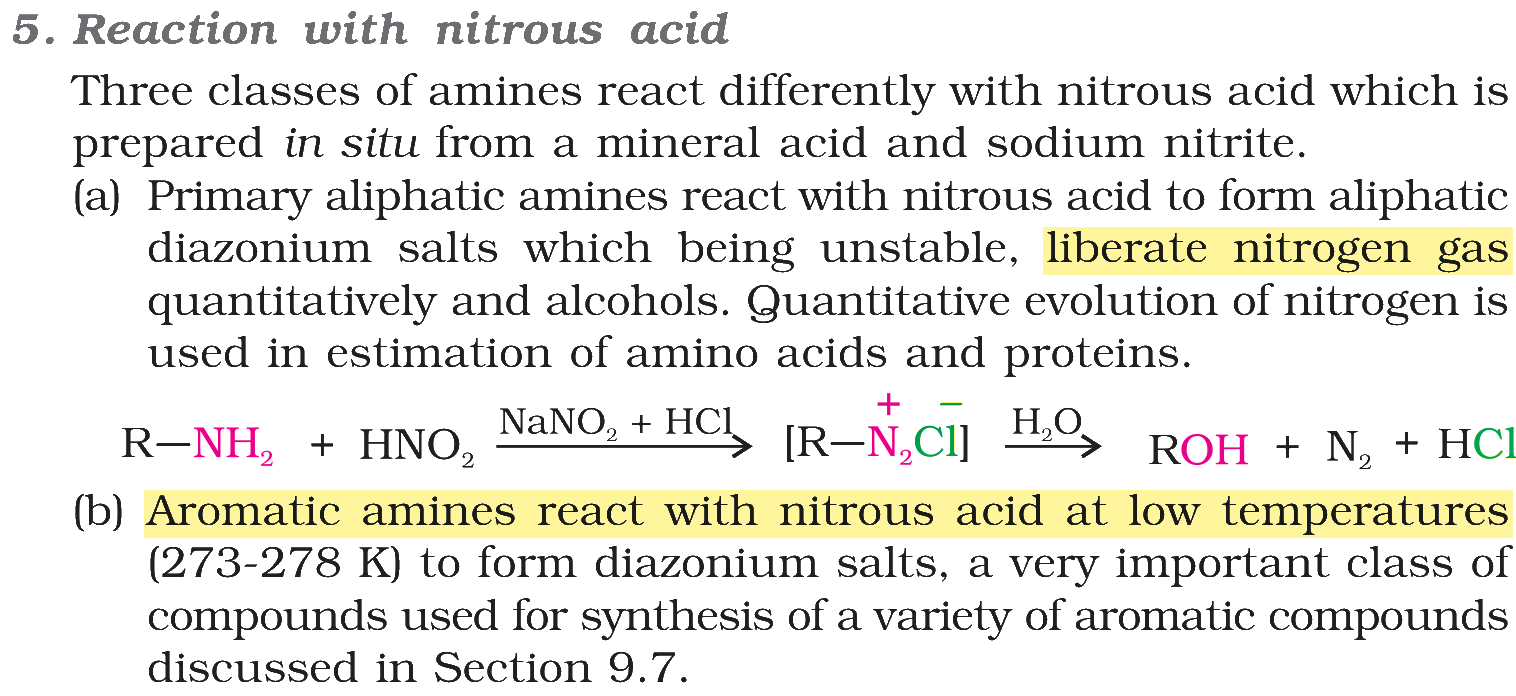
To tell two amines apart, the reagent must behave differently with them. Aniline and ethanamine are both primary amines, so tests that pick out primary amines give the same result with both. Nitrous acid (made in the cold from \( \ce{NaNO2} \) and HCl) separates them because aliphatic and aromatic diazonium salts differ in stability.
Ethanamine gives an aliphatic diazonium salt that is unstable even in the cold and decomposes at once, with brisk evolution of nitrogen gas:
\( \displaystyle \ce{C2H5NH2 + HNO2} \xrightarrow{\ce{NaNO2} + \ce{HCl}} \ce{[C2H5N2+Cl^-]} \xrightarrow{\ce{H2O}} \ce{C2H5OH + N2 ^ + HCl} \)
Aniline at 273-278 K gives benzenediazonium chloride, which is stable at that temperature, so no gas is evolved. The solution, added to alkaline β-naphthol, gives an orange-red azo dye:
\( \displaystyle \ce{C6H5NH2 + NaNO2 + 2HCl} \xrightarrow{273-278\ \mathrm{K}} \ce{C6H5N2+Cl^- + NaCl + 2H2O} \)
So the two amines are distinguished by the nitrous acid test.
Why the other options are incorrect
Option (1) Hinsberg’s Reagent — Incorrect. Benzenesulphonyl chloride tells primary, secondary and tertiary amines apart; both these primary amines give an N-substituted sulphonamide that dissolves in alkali, so they behave alike.
Option (2) Isocyanide Test — Incorrect. The carbylamine reaction is given by every primary amine, aliphatic or aromatic, so both give the foul smell of an isocyanide.
Option (4) Tollen’s Test — Incorrect. Tollens’ reagent detects aldehydes (silver mirror); neither amine reduces it.
NCERT (2026-27 edition):
Reaction with Nitrous Acid