CUETMOCK
  • Pricing
  • Mentors
Log inStart freeStart free mocks→

First test, then trust

Try a free CUET mock test.

Join 5,00,000+ students who rehearsed exam day on the exact NTA screen before sitting CUET. On the web and on Android.

Start free mocks →Get the Android app
CUETMOCK

India's #1 CUET Mock Test Platform. Original NCERT-based questions on the exact NTA exam screen — trusted by 5,00,000+ students since CUET 2022.

Get it onGoogle PlayScan to download the CUETMOCK app

Mock tests

  • CUET mock test series
  • Browse all papers
  • Commerce mocks
  • Humanities (Arts) mocks
  • Science mocks
  • Languages & GAT mocks
  • Free practice questions
  • Pricing

Resources

  • CUET exam guide
  • CUET syllabus
  • Universities accepting CUET
  • Expert blogs
  • News & notifications
  • Webinars & counselling
  • CUET score calculator
  • How we estimate your rank
  • FAQs

Company

  • About us
  • Our leadership & team
  • Our toppers
  • Mentors
  • For schools
  • Contact us
  • Terms
  • Privacy
  • Refund policy

Talk to us

+91 7696 6630 56info@cuetmock.comWhatsApp us

Our other platforms

  • JEE Mock — For IIT-JEE aspirants
  • NEET Mock — For NEET aspirants

Newsletter

Exam updates, study material and offers — no spam.

© 2026 NYC Ventures Pvt. Ltd.

701-702, Royal Business Park, Zirakpur, Punjab - 140603

  • Terms of use
  • Privacy policy
  • Refund policy
  • Contact us

iCUETMOCK is an independent preparation platform, not affiliated with the National Testing Agency (NTA). Always check exam details on the official NTA website.

  • Home
  • Mock tests
  • CUET guide
  • Pricing
  • Log in
Home/Practice questions/Economics
EconomicsMicro Economics: Theory of Consumer behaviour

The Government wants to reduce the demand for electricity. If the ela…

The Government wants to reduce the demand for electricity. If the elasticity of demand for electricity is 0.5 and it wants to reduce the demand by 10%, then it should increase the price of electricity by ___________.

Answer & explanation+

Correct answer: option 2

The correct answer is Option (2) → 20%

Given:

Elasticity of demand = 0.5

Required fall in demand = 10%

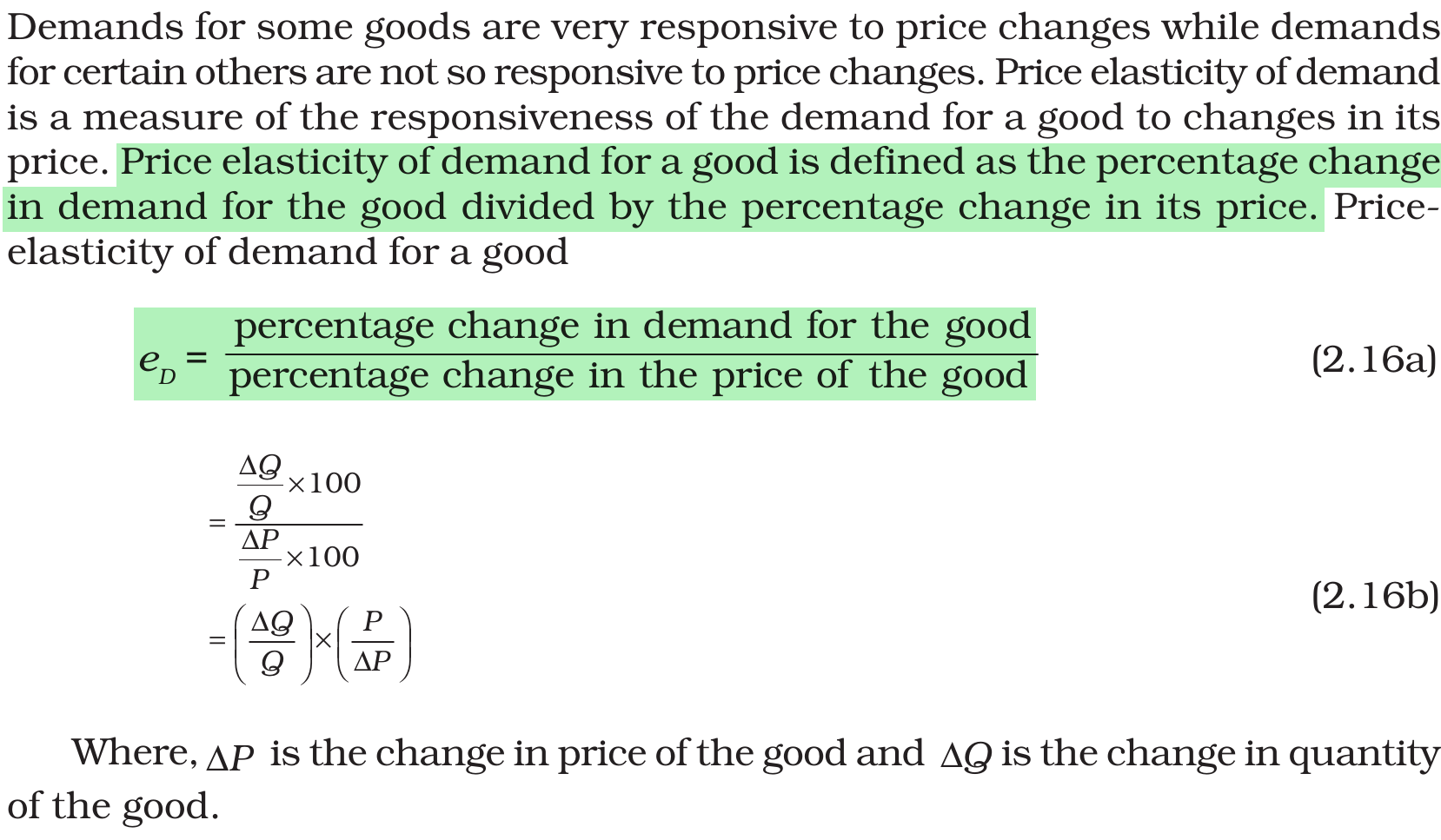
Price elasticity of demand is the percentage change in quantity divided by the percentage change in price, taken here without its minus sign.

0.5 = 10 / Percentage change in price

Percentage change in price = 10 / 0.5 = 20%

NCERT (2026-27): Introductory Microeconomics — Chapter 2: Theory of Consumer Behaviour

NCERT extract

Advertisement

Practise more on Micro Economics: Theory of Consumer behaviour

Chapter-wise mocks on the real NTA exam screen, with solutions and your rank. Your first mocks are free.

Start free mocks →

Advertisement

Next questions

  1. Knowing that the chemistry of lanthanoid is dominated by its (+3) oxidation state, which of the following statement is incorrect?Chemistry · Inorganic: D and F Block Elements
  2. According to Allport, a single trait that dominates an individual's entire personality is known as _________.Psychology · Self and Personality
  3. Which of the following Sultanates emerged around 1490?History · Medieval India: An Imperial Capital: Vijayanagara
  4. Pravasi Bharatiya Divas or NRI Day is formally observed on 9 January to celebrate the day __________.General Aptitude Test · General Knowledge
  5. From the given options, select the most appropriate word to fill in the blank in the given sentence:- Her new book was wonderfully ____ of…English · Fill Blanks
  6. When a new partner brings goodwill in the partnership firm, then goodwill A/c is debited for transferring that goodwill to partners account…Accountancy Part A · Admission of a Partner
  7. Which of the following reactants on heating with alkali and chloroform produces unpleasant smelling carbylamines?Chemistry · Organic: Haloalkanes and Haloarenes
  8. When the due date of the calls arrives, how are the "Calls in Advance" adjusted in the company's accounts?Accountancy Part A · Accounting for Shares
  9. Who has written the book 'Disability Studies in India: Retrospect and Prospect'?Sociology · Indian Society: Patterns of Social Inequality and Exclusion
  10. Match List I with List IIList IList IIA. A Unit of LengthI. Chandrashekar limitB. A Unit of MassII. Leap yearC. A Unit of TimeIII. ParsecD.…General Aptitude Test · General Knowledge