Match the concept in List - I with their explanation in List - II.
| LIST-I (Concept) | LIST-II (Explanation) | ||
| (A) | Gender | (I) | Social system with dominance of males |
| (B) | Patriarchy | (II) | Conversion of gender status of body into opposite gender |
| (C) | Race | (III) | Biological category |
| (D) | Trans Gender | (IV) | Socially constructed |
Choose the correct answer from the options given below:
Answer & explanation
Correct answer: option 3
The correct answer is Option (3) → (A)-(IV), (B)-(I), (C)-(III), (D)-(II)
(A) Gender — this matches (IV) Socially constructed. Gender is the social side of being a man or a woman. Scholars have shown that the inequalities between men and women are social rather than natural: no biological reason explains why so few women are found in positions of public power.
(B) Patriarchy — this matches (I) Social system with dominance of males. A patriarchal family structure exists where the men exercise authority and dominance.
(C) Race — this matches (III) Biological category. Race groups people by inherited physical features such as skin colour, so in this list it is the category drawn from the body.
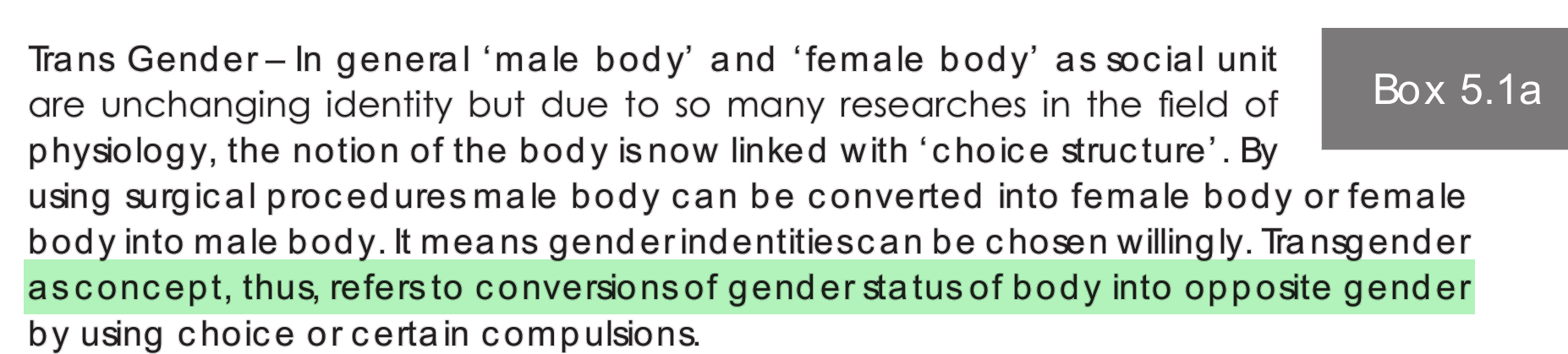
(D) Trans Gender — this matches (II) Conversion of gender status of body into opposite gender. By surgical procedures a male body can be converted into a female body or a female body into a male one, so transgender refers to conversions of the gender status of the body into the opposite gender, by choice or by certain compulsions.
Note: ‘Race’ as a biological category is not in NCERT (2025-26); explained here for the benefit of the students.
NCERT (2025-26): “5.3 Struggle for women’s equality and rights … Because of the obvious biological and physical differences between men and women, gender inequality is often treated as natural. However, despite appearances, scholars have shown that the inequalities between men and women are social rather than natural. For example, there are no biological reasons that can explain why so few women are found in positions of public power. Nor can nature explain why women generally receive a smaller or no share in family property in most societies.…” “3.3 Family and Kinship … A patriarchal family structure exists where the men exercise authority and dominance, and matriarchy where the women play a similarly dominant role. However, matriarchy – unlike patriarchy – has been a theoretical rather than an empirical concept.…”
Box 5.1a (NCERT 2025-26) |