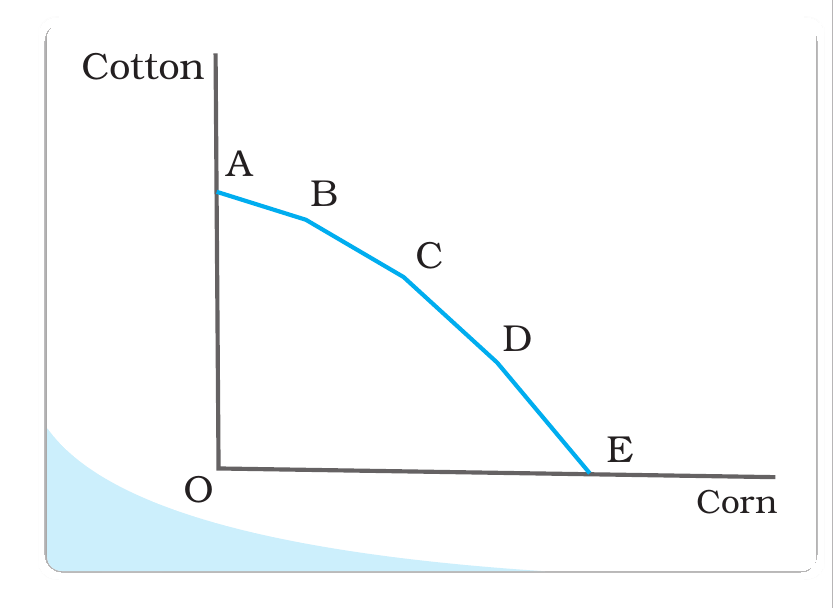
If the marginal rate of transformation is constant throughout, the production possibilities frontier will be
Answer & explanation
Correct answer: option 3
The correct answer is Option (3) → Downward sloping and linear.
The production possibilities frontier (PPF) shows the combinations of two goods an economy can produce when its resources are fully used. The marginal rate of transformation is how much of one good must be given up to make one more unit of the other. It is the steepness of the PPF at any point.
Option (1) Downward sloping and concave to the origin. — Incorrect. A concave PPF gets steeper as we move down it. So the amount given up keeps rising and is not constant.
Option (2) Downward sloping and convex to the origin. — Incorrect. A convex PPF gets flatter as we move down it. So the amount given up keeps falling and is not constant.
Option (3) Downward sloping and linear. — Correct. If the same amount is given up for every extra unit, the slope never changes. A line with the same slope throughout is straight.
Option (4) Upward sloping straight line. — Incorrect. With resources fully used, more of one good means less of the other. So the PPF must slope downward.
Note: The term ‘marginal rate of transformation’ is not in any of the NCERT books (2026-27, 2025-26, 2023-24 or pre-rationalised). They call the amount given up the opportunity cost of an additional unit.
NCERT (2026-27): “Production Possibility Frontier … The production possibility frontier gives the combinations of corn and cotton that can be produced when the resources of the economy are fully utilised.… If more of the scarce resources are used in the production of corn, less resources are available for the production of cotton and vice versa. Therefore, if we want to have more of one of the goods, we will have less of the other good. Thus, there is always a cost of having a little more of one good in terms of the amount of the other good that has to be forgone. This is known as the opportunity costa of an additional unit of the goods.…”
|