CUETMOCK
  • Pricing
  • Mentors
Log inStart freeStart free mocks→

First test, then trust

Try a free CUET mock test.

Join 5,00,000+ students who rehearsed exam day on the exact NTA screen before sitting CUET. On the web and on Android.

Start free mocks →Get the Android app
CUETMOCK

India's #1 CUET Mock Test Platform. Original NCERT-based questions on the exact NTA exam screen — trusted by 5,00,000+ students since CUET 2022.

Get it onGoogle PlayScan to download the CUETMOCK app

Mock tests

  • CUET mock test series
  • Browse all papers
  • Commerce mocks
  • Humanities (Arts) mocks
  • Science mocks
  • Languages & GAT mocks
  • Free practice questions
  • Pricing

Resources

  • CUET exam guide
  • CUET syllabus
  • Universities accepting CUET
  • Expert blogs
  • News & notifications
  • Webinars & counselling
  • CUET score calculator
  • How we estimate your rank
  • FAQs

Company

  • About us
  • Our leadership & team
  • Our toppers
  • Mentors
  • For schools
  • Contact us
  • Terms
  • Privacy
  • Refund policy

Talk to us

+91 7696 6630 56info@cuetmock.comWhatsApp us

Our other platforms

  • JEE Mock — For IIT-JEE aspirants
  • NEET Mock — For NEET aspirants

Newsletter

Exam updates, study material and offers — no spam.

© 2026 NYC Ventures Pvt. Ltd.

701-702, Royal Business Park, Zirakpur, Punjab - 140603

  • Terms of use
  • Privacy policy
  • Refund policy
  • Contact us

iCUETMOCK is an independent preparation platform, not affiliated with the National Testing Agency (NTA). Always check exam details on the official NTA website.

  • Home
  • Mock tests
  • CUET guide
  • Pricing
  • Log in
Home/Practice questions/Sociology
SociologySocial Change and Development in India: Change and Development in Rural Society

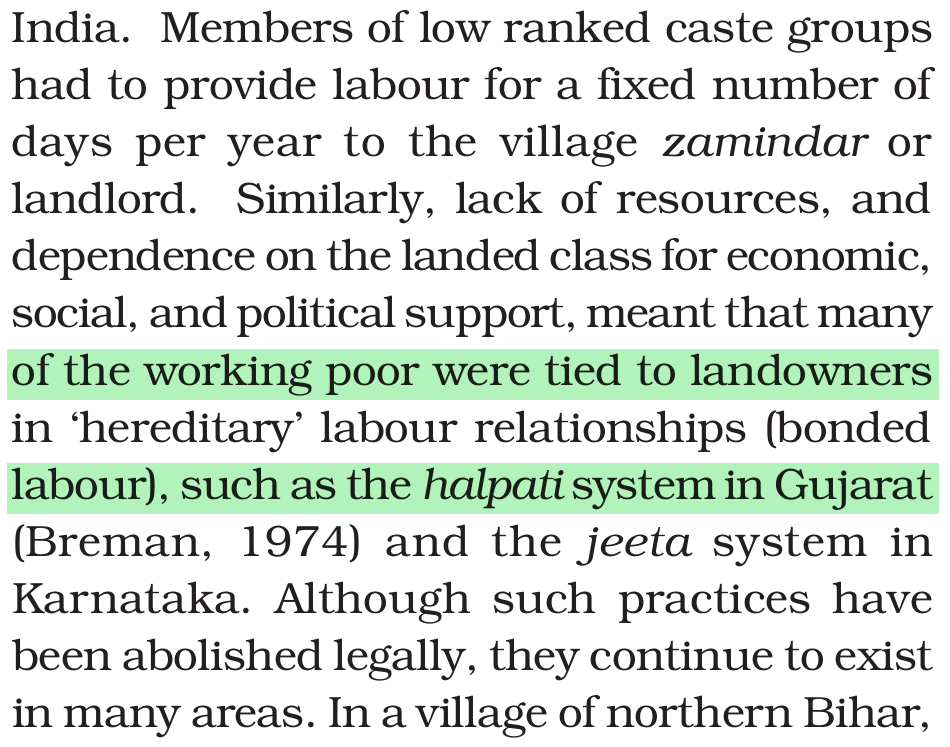
The bonded labour system of 'Halpati' was prevalent in:

The bonded labour system of 'Halpati' was prevalent in:

Answer & explanation+

Correct answer: option 1

The correct answer is Option (1) → Gujarat

Note: The examples of bonded labour, the halpati system in Gujarat and the jeeta system in Karnataka, in the section ‘Agrarian Structure: Caste and Class in Rural India’ of the chapter ‘Change and Development in Rural Society’, were there in the pre-rationalised NCERT, which NTA followed in 2023. These examples have been deleted from the NCERT book (2025-26), though the chapter and its lines on ‘hereditary’ labour relationships are still there.


NCERT (2025-26): “4.1 Agrarian Structure: Caste and Class in Rural India … The rough correspondence between caste and class means that typically the upper and middle castes also had the best access to land and resources, and hence to power and privilege. This had important implications for the rural economy and society. In most regions of the country, a ‘proprietary caste’ group owns most of the resources and can command labour to work for them. Until recently, practices such as begar or free labour were prevalent in many parts of northern India. Members of low ranked caste groups had to provide labour for a fixed number of days per year to the village zamindar or landlord. Many of the working poor were tied to landowners in ‘hereditary’ labour relationships. Although such practices have been abolished legally, they continue to exist in many areas.”

NCERT extract

Agrarian Structure: Caste and Class in Rural India (Pre-rationalised NCERT)

Advertisement

Practise more on Social Change and Development in India: Change and Development in Rural Society

Chapter-wise mocks on the real NTA exam screen, with solutions and your rank. Your first mocks are free.

Start free mocks →

Advertisement

Next questions

  1. Identify "Y" in the following reaction:Chemistry · Organic: Aldehydes, Ketones and Carboxylic Acids
  2. Select the option that can be used as a one-word substitute for the given group of words. Cancel or do away with (a law or agreement)English · One Word
  3. If any of the parties is not satisfied by the order of District Commission, he can appeal against such order to the State Commission on the…Business Studies · Consumer Protection
  4. Which of the following will have the maximum flocculation value for arsenic sulphide solution?Chemistry · Physical: Surface Chemistry
  5. Six people have different heights. U is the tallest one. P is taller than R, who is shorter than S. Q is shorter than R, but taller than T.…General Aptitude Test · Verbal Reasoning
  6. Which Indian president used the pocket veto for the Indian Post Office (Amendment) Bill, 1986?General Aptitude Test · General Knowledge
  7. Three of the following taxes have been subsumed in GST. Which one is the odd one out?Economics · Macro Economics: Government Budget and Economy
  8. Which of the following is a net increase or decrease in cash and cash equivalents?Accountancy Part B · Cash Flow Statement
  9. Choose the correct Exclamatory form of the sentence from the options given below: The restaurant was expensive.English · Kinds of Sentence
  10. A man rows a boat a certain distance downstream in 9 hours, while it takes 18 hours to row the same distance upstream. How many hours will…General Aptitude Test · Numerical Ability