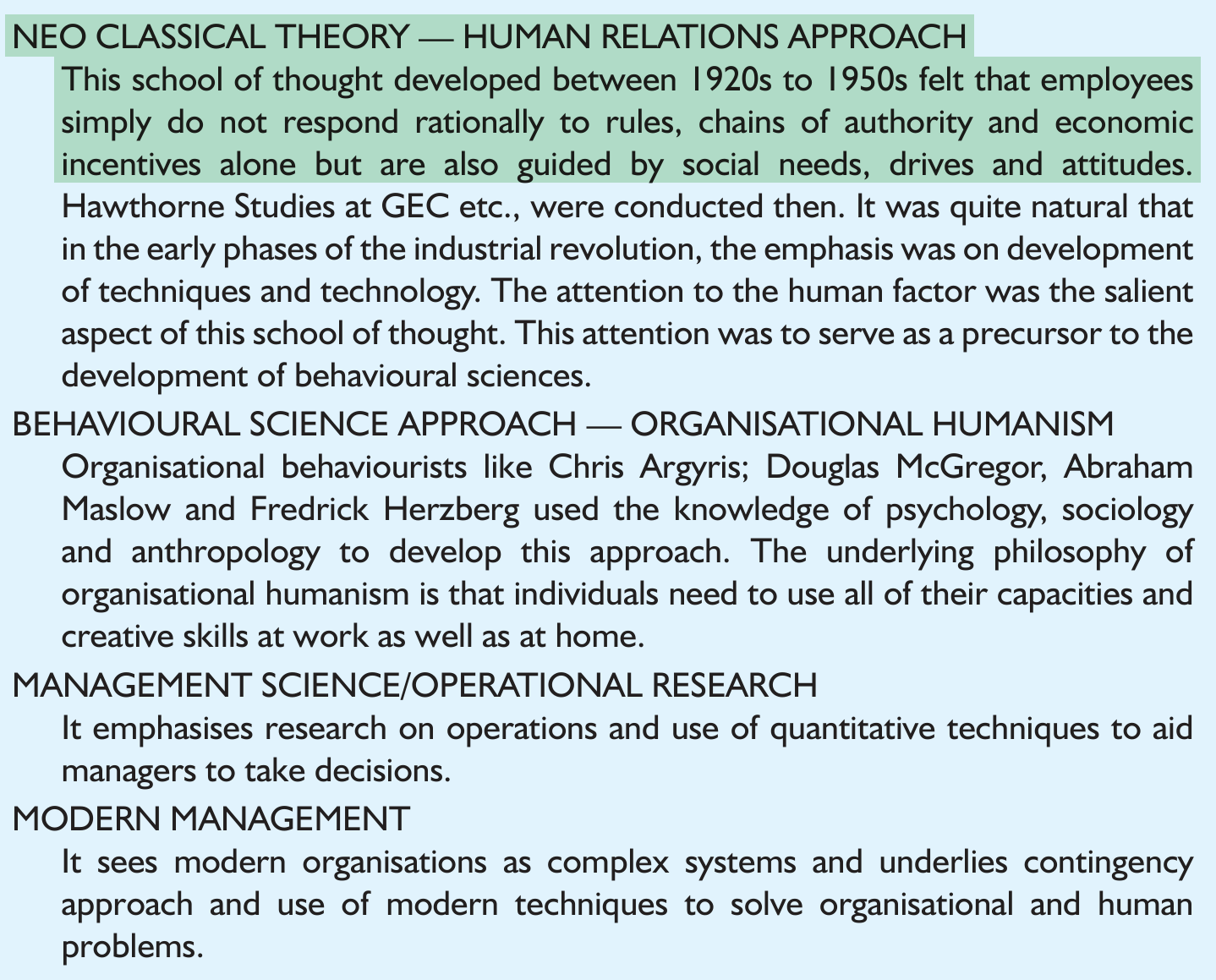
Which management theory felt that employees simply do not respond rationally to rules, chains of authority and economic incentives alone but are also guided by social needs, drives and attitudes?
Answer & explanation
Correct answer: option 4
The correct answer is Option (4) → Neo-Classical Theory
Option (1) Classical Management Theory — Incorrect. In the classical phase, the rational economic view took people to be moved mainly by economic gain. The idea that rules and pay are not enough came after it.
Option (2) Modern Management — Incorrect. This latest phase sees organisations as complex systems and uses the contingency approach to solve organisational and human problems. Its focus is the organisation as a whole system; the idea about social needs came much earlier, from the human relations school.
Option (3) Behavioural Science Approach — Incorrect. This approach used psychology, sociology and anthropology. It holds that individuals need to use all their capacities and creative skills. It came later and grew out of the human relations school; the finding about social needs, drives and attitudes belongs to that earlier school.
Option (4) Neo-Classical Theory — Correct. The Neo-Classical Theory, or Human Relations Approach, of the 1920s to 1950s found that employees are also guided by social needs, drives and attitudes. Its main feature was attention to the human factor, seen in the Hawthorne Studies.
NCERT (2026-27 Edition):
|