
CUETMOCK
  • Pricing
  • Mentors
Log inStart freeStart free mocks→

First test, then trust

Try a free CUET mock test.

Join 5,00,000+ students who rehearsed exam day on the exact NTA screen before sitting CUET. On the web and on Android.

Start free mocks →Get the Android app
CUETMOCK

India's #1 CUET Mock Test Platform. Original NCERT-based questions on the exact NTA exam screen — trusted by 5,00,000+ students since CUET 2022.

Get it onGoogle PlayScan to download the CUETMOCK app

Mock tests

  • CUET mock test series
  • Browse all papers
  • Commerce mocks
  • Humanities (Arts) mocks
  • Science mocks
  • Languages & GAT mocks
  • Free practice questions
  • Pricing

Resources

  • CUET exam guide
  • CUET syllabus
  • Universities accepting CUET
  • Expert blogs
  • News & notifications
  • Webinars & counselling
  • CUET score calculator
  • How we estimate your rank
  • FAQs

Company

  • About us
  • Our leadership & team
  • Our toppers
  • Mentors
  • For schools
  • Contact us
  • Terms
  • Privacy
  • Refund policy

Talk to us

+91 7696 6630 56info@cuetmock.comWhatsApp us

Our other platforms

  • JEE Mock — For IIT-JEE aspirants
  • NEET Mock — For NEET aspirants

Newsletter

Exam updates, study material and offers — no spam.

© 2026 NYC Ventures Pvt. Ltd.

701-702, Royal Business Park, Zirakpur, Punjab - 140603

  • Terms of use
  • Privacy policy
  • Refund policy
  • Contact us

iCUETMOCK is an independent preparation platform, not affiliated with the National Testing Agency (NTA). Always check exam details on the official NTA website.

  • Home
  • Mock tests
  • CUET guide
  • Pricing
  • Log in
Home/Practice questions/Chemistry
ChemistryOrganic: Alcohols, Phenols and Ethers

Choose the correct sequential order for the conversion of 3-methyl bu…

Choose the correct sequential order for the conversion of 3-methyl butan-1-ol to 2-methylpropanol
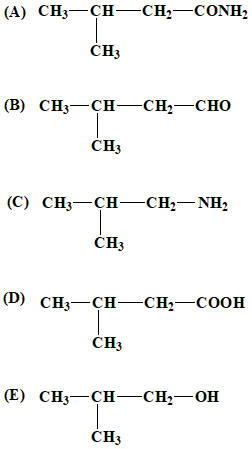
Figure for Q9

Choose the correct answer from the options given below:

Answer & explanation+

Correct answer: option 2

The correct answer is Option (2) → B, D, A, C, E

The alcohol has 5 carbons and the product, 2-methylpropan-1-ol (E), has 4, so one carbon has to be removed. The step that removes a carbon is the Hofmann bromamide degradation of an amide. So the route first builds up that amide from the alcohol, then degrades it to the amine and turns the amine into the alcohol.

  • B — first. PCC oxidises the primary alcohol only as far as the aldehyde, 3-methylbutanal.

        \( \ce{(CH3)2CHCH2CH2OH} \xrightarrow{\ce{PCC}} \ce{(CH3)2CHCH2CHO} \)

  • D — second. Acidified \( \ce{KMnO4} \) oxidises the aldehyde to 3-methylbutanoic acid.

        \( \ce{(CH3)2CHCH2CHO + [O]} \xrightarrow{\ce{KMnO4/H+}} \ce{(CH3)2CHCH2COOH} \)

  • A — third. The acid and ammonia form the ammonium salt, which loses water on heating to give 3-methylbutanamide.

        \( \ce{(CH3)2CHCH2COOH + NH3 -> (CH3)2CHCH2COO^-NH4^+} \xrightarrow{\Delta} \ce{(CH3)2CHCH2CONH2 + H2O} \)

  • C — fourth. Bromine and NaOH convert the amide into an amine with one carbon atom less, 2-methylpropan-1-amine; the carbonyl carbon leaves as sodium carbonate.

        \( \ce{(CH3)2CHCH2CONH2 + Br2 + 4NaOH -> (CH3)2CHCH2NH2 + Na2CO3 + 2NaBr + 2H2O} \)

  • E — last. Nitrous acid (from \( \ce{NaNO2 + HCl} \)) converts the primary aliphatic amine into the alcohol, 2-methylpropan-1-ol, with the loss of nitrogen gas.

        \( \ce{(CH3)2CHCH2NH2 + HNO2} \xrightarrow{\ce{NaNO2 + HCl}} \ce{(CH3)2CHCH2OH + N2 + H2O} \)

NCERT (2026-27 edition):
Hoffmann Bromamide Degradation Reaction
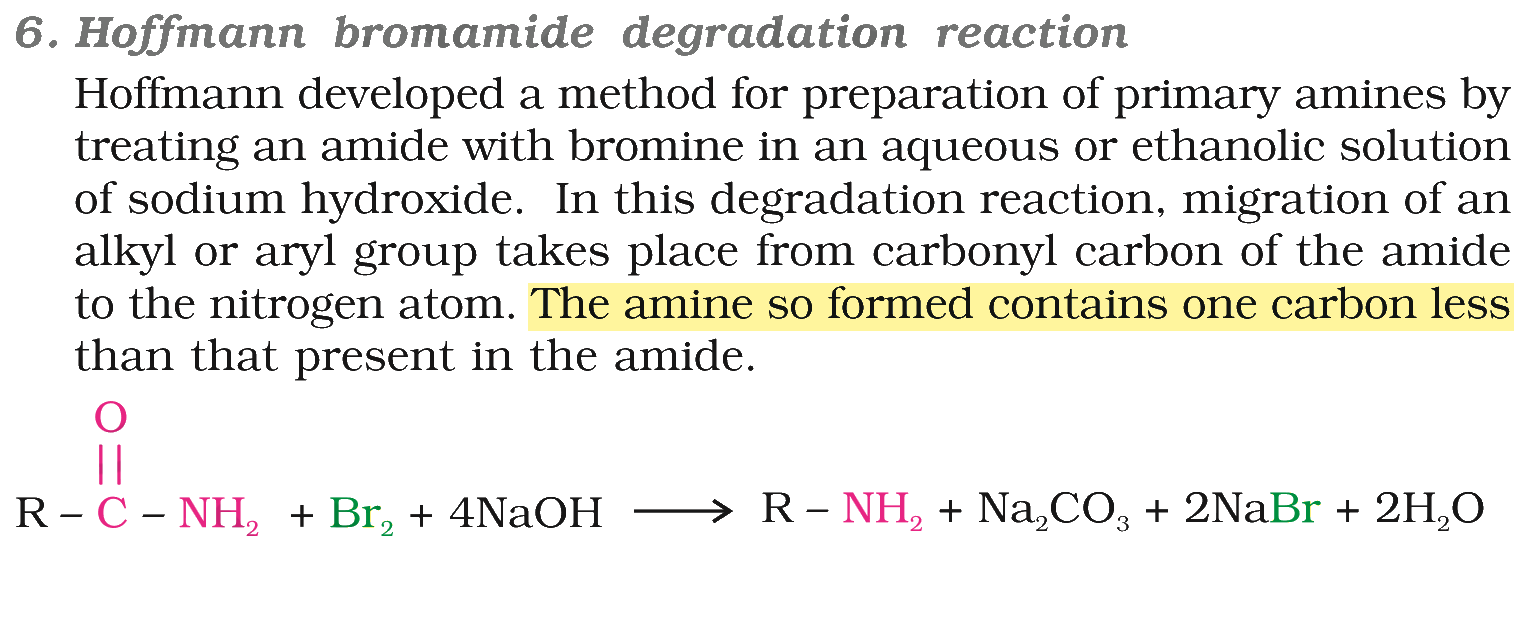
Textbook extract

Advertisement

Practise more on Organic: Alcohols, Phenols and Ethers

Chapter-wise mocks on the real NTA exam screen, with solutions and your rank. Your first mocks are free.

Start free mocks →

Advertisement

Next questions

  1. If α=∫limits_0^1 e^9 x+3 tan ^-1 x≤ft((12+9 x^2)/(1+x^2)) d x, where tan ^-1 x takes only principal values, then the value of ≤ft(log _e|1+…Maths. Section B1 · Definite Integration
  2. Match List-I with List-IIList-IList-IICommon NameIUPAC Name(A) m-cresol(I) Benzene- 1,2- diol(B) Resorcinol(II) 3-Methylphenol(C) Catechol(…Chemistry · Organic: Alcohols, Phenols and Ethers
  3. The function f(x) = x^x has a stationary point atMaths. Section B1 · Applications of Derivatives
  4. The loud cry of a peacock is called a ______.English · Young Ones and Sound
  5. In 1928, to take revenge for the death of Lala Lajpat Rai, Bhagat Singh and his comrades killed a British police official named _________.General Aptitude Test · General Knowledge
  6. "FreshBites offers a range of organic, cold-pressed juices with no artificial additives, emphasizing health benefits". Identify the marketi…Business Studies · Marketing
  7. From the given options select the one that is opposite in meaning to the given words: “ACQUITTED”English · Antonyms
  8. The question below is followed by two statements numbered I and II. Decide whether the data given in the statements are sufficient to answe…General Aptitude Test · Verbal Reasoning
  9. Assertion: Financial statements are prepared on the basis of facts in the form of cost data recorded in accounting books. Reasoning: The fi…Accountancy Part B · Financial Statements of a Company
  10. Which of the following is an example of a recently extinct species?Biology · Biodiversity and Conservation