
A capacitor is a system of two conductors separated by an insulating medium. Capacitance of this system is determined purely geometrically, by the shapes, size and relative position of the conductors. The medium between the two conductors can be air or a dielectric. The way the dielectric is inserted accordingly by capacitance changes. Electric energy is stored in the capacitors. The capacitor can be connected in series or in parallel in an electric circuit.
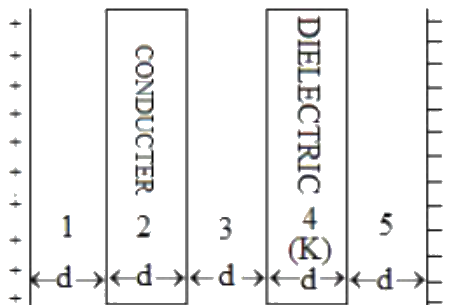
A dielectric slab and a conducting slab of thickness \( d \) is inserted inside the charged capacitor plates. \( k \) is the dielectric constant. The electric field in the regions 2, 3, 4 are.
Answer & explanation
Correct answer: option 3
The correct answer is Option (3) → zero, \( \displaystyle\frac{\sigma}{\varepsilon_0}, \frac{\sigma}{k\varepsilon_0} \)
Between plates carrying surface charge density \( \pm\sigma \), the field in an empty gap is \( E_0 = \sigma/\varepsilon_0 \). Inside a conductor the electrostatic field is always zero, and inside a dielectric the field is reduced by the factor \( k \).
From the figure, region 2 is the conducting slab, region 3 is an empty gap and region 4 is the dielectric slab.
\( E_2 = 0 \quad \text{(inside the conductor)} \)
\( \displaystyle E_3 = E_0 = \frac{\sigma}{\varepsilon_0} \quad \text{(empty gap)} \)
\( \displaystyle E_4 = \frac{E_0}{k} = \frac{\sigma}{k\varepsilon_0} \quad \text{(dielectric)} \)
So the fields in regions 2, 3, 4 are zero, \( \sigma/\varepsilon_0 \) and \( \sigma/(k\varepsilon_0) \).