According to the electrochemical series, which of the following statements is incorrect?
Answer & explanation
Correct answer: option 4
The correct answer is Option (4) → Fluoride ion is a strong oxidizing agent.
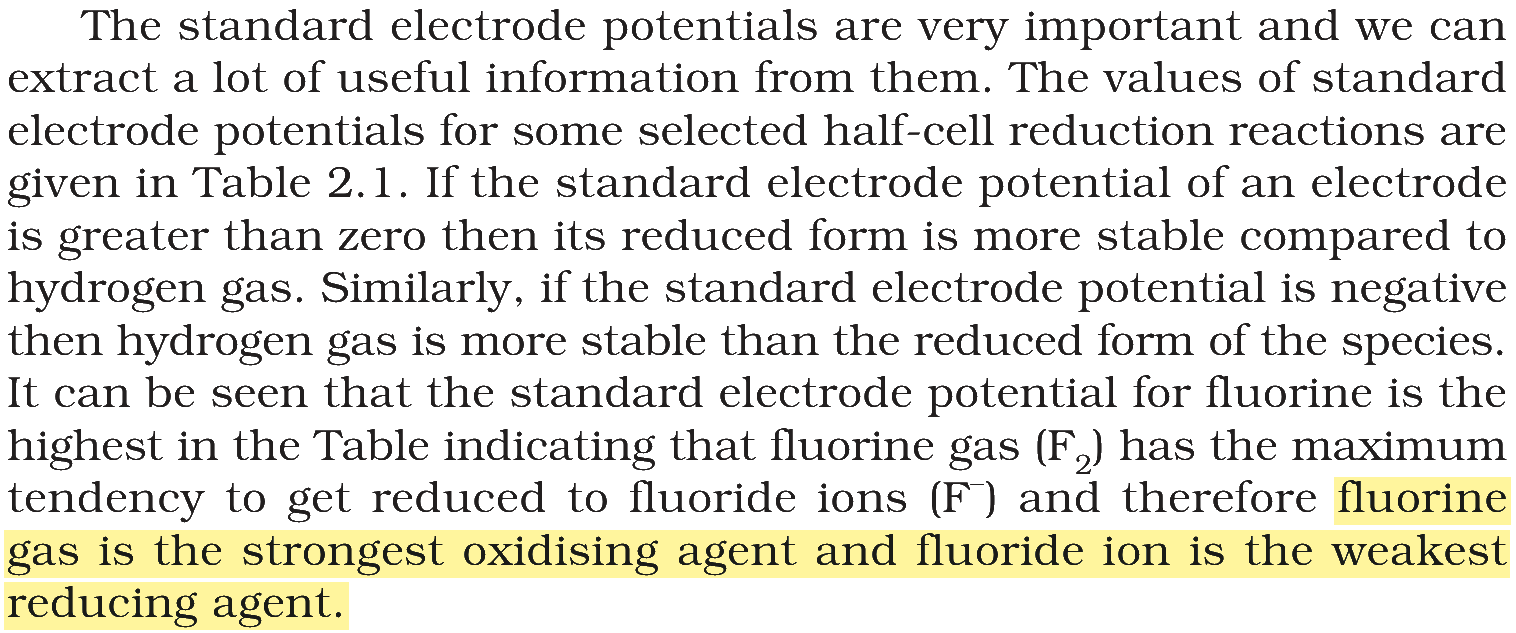
In the electrochemical series, the higher the standard reduction potential of a half-cell, the greater the tendency of its oxidised form to gain electrons, so the stronger it is as an oxidising agent. Fluorine has the highest value of all:
\( \displaystyle \ce{F2(g) + 2e^- -> 2F^-(aq)} \qquad E^\circ = +2.87\,\mathrm{V} \)
Fluorine gas is therefore the strongest oxidising agent, and its reduced form, the fluoride ion, is the weakest reducing agent. The fluoride ion already has a complete octet (configuration of neon) and cannot accept another electron, so it cannot act as an oxidising agent at all.
Option (1) Fluorine has the highest standard electrode potential. — A correct statement. At +2.87 V the \( \ce{F2}/\ce{F^-} \) couple stands at the top of the electrochemical series.
Option (2) Fluorine gas has a strong tendency to get reduced. — A correct statement. A high positive reduction potential means a strong tendency to gain electrons.
Option (3) Fluorine gas is a strong oxidizing agent. — A correct statement. \( \ce{F2} \) is the strongest oxidising agent in the series.
Option (4) Fluoride ion is a strong oxidizing agent. — The incorrect statement. The fluoride ion has a complete octet and cannot gain another electron; it is the weakest reducing agent, not an oxidising agent.
NCERT (2026-27 edition):
Measurement of Electrode Potential – …