Read the following passage and answer the following questions.
The First Nuclear explosion was undertaken by India in 1974. Our first PM had always put faith in science and technology for rapidly building a modern India. A significant component of India's industrialisation plans was the nuclear programme initiated in the late 1940s under the guidance of Homi J. Bhabha.
When Communist China conducted a nuclear test in 1964 the permanent members of the UN Security Council tried to impose the Nuclear Non-proliferation Treaty (NPT) of 1968. India always considered the NPT as discriminatory and had refused to sign it, and also further refused to sign the CTBT.
When India conducted its first nuclear test, it was termed as peaceful explosion. Later India conducted a series of tests, Pakistan soon followed. India's Nuclear doctrine of credible minimum nuclear deterrence professes "No first use".
CTBT stands for:
Answer & explanation
Correct answer: option 2
The correct answer is Option (2) → Comprehensive Test Ban Treaty
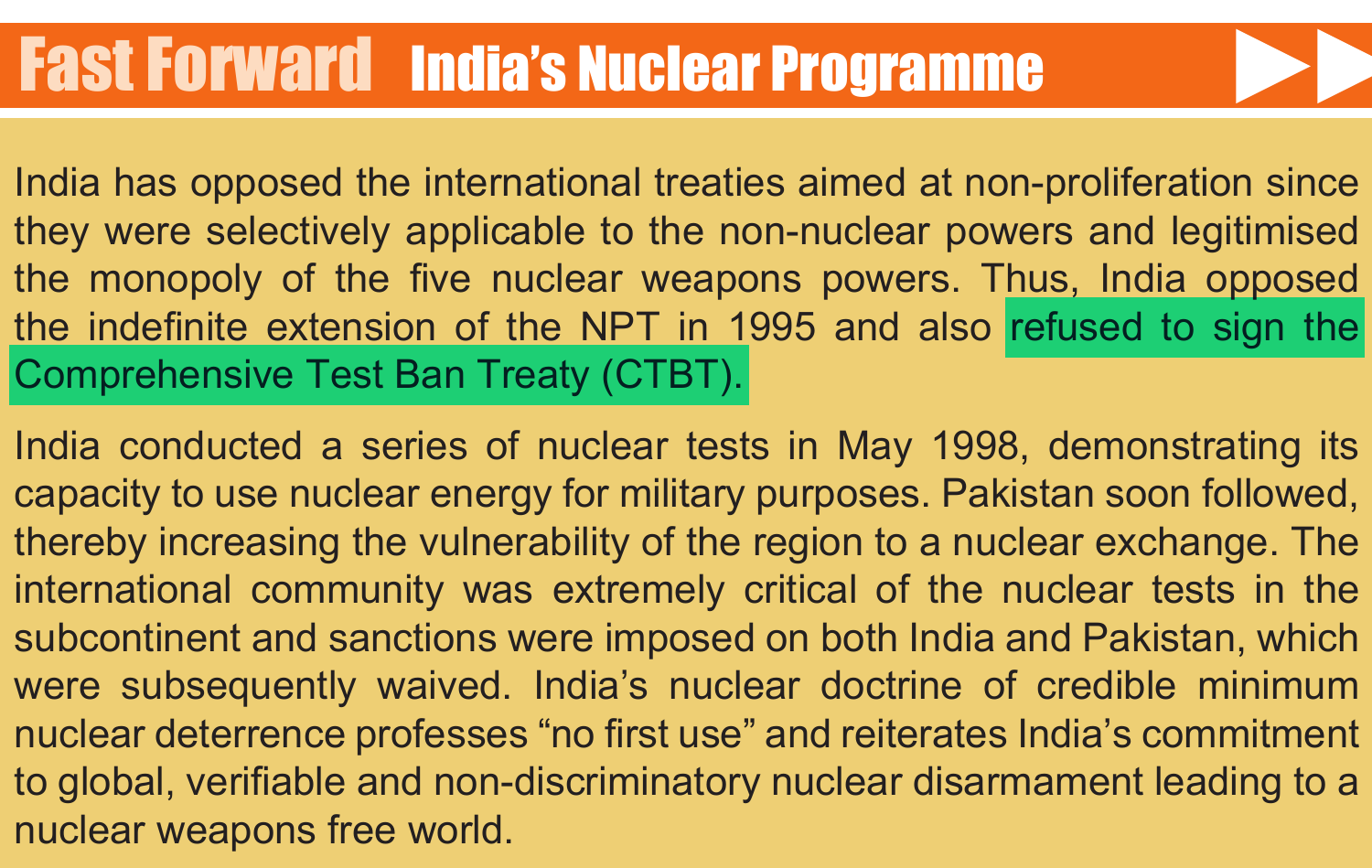
India opposed the indefinite extension of the NPT in 1995 and also refused to sign the Comprehensive Test Ban Treaty (CTBT).
Note: The passage of Q6 to Q10 is taken from the NCERT section ‘India’s nuclear policy’ of the chapter ‘India’s External Relations’. The full form of CTBT and the year of the second series of tests are not in the passage but in the Fast Forward box ‘India’s Nuclear Programme’ on the next page, so read the boxes beside a section too.
NCERT (2026-27): Politics in India since Independence — Chapter 4: India’s External Relations
|