
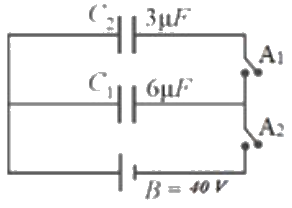
In the circuit shown below, \( C_1 = 6\,\mu\mathrm{F} \), \( C_2 = 3\,\mu\mathrm{F} \) and battery \( B = 40\,\mathrm{V} \). Initially, switch \( A_1 \) is opened and the switch \( A_2 \) is closed. Now switch \( A_2 \) is opened and \( A_1 \) is closed. The charge on \( C_2 \) will be
Answer & explanation
Correct answer: option 3
The correct answer is Option (3) → \( 80\,\mu\mathrm{C} \)
The circuit works in two stages. In the first stage the battery charges \( C_1 \) alone; in the second stage the charge on \( C_1 \) is shared with \( C_2 \).
Stage 1. With \( A_1 \) open and \( A_2 \) closed, only \( C_1 \) is connected to the battery, so it is charged to \( 40\,\mathrm{V} \) while \( C_2 \) stays uncharged.
\( \displaystyle Q_1 = C_1 V = 6 \times 40 = 240\,\mu\mathrm{C} \)
Stage 2. With \( A_2 \) open and \( A_1 \) closed, the battery is cut off and \( C_1 \) and \( C_2 \) are joined in parallel. The total charge of \( 240\,\mu\mathrm{C} \) is conserved, and both settle at a common potential.
\( \displaystyle V = \frac{Q}{C_1 + C_2} = \frac{240}{6 + 3} = \frac{80}{3}\,\mathrm{V} \)
\( \displaystyle Q_2 = C_2 V = 3 \times \frac{80}{3} = 80\,\mu\mathrm{C} \)
Shortcut: Parallel capacitors share the charge in the ratio of their capacitances: \( Q_2 = 240 \times 3/9 = 80\,\mu\mathrm{C} \).