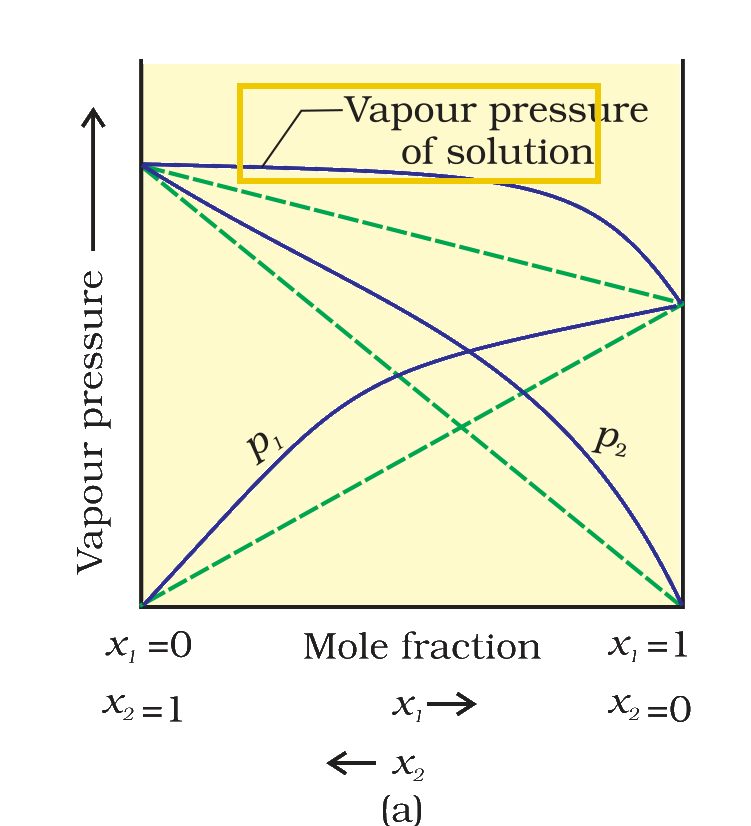
The vapour pressure curve of the mixture of ethanol and acetone is higher than its constituents because:
Answer & explanation
Correct answer: option 1
The correct answer is Option (1) → Weakening of interactions between molecules takes place
A solution shows positive deviation from Raoult’s law when the A–B interactions are weaker than the A–A and B–B interactions. The molecules then escape more easily than from the pure liquids, so the vapour pressure is higher than predicted.
Why the other options are incorrect
Option (2) Strengthening of interactions between molecules takes place — Incorrect. Stronger A–B interactions lower the vapour pressure and give a negative deviation (as in chloroform + acetone).
Option (3) New hydrogen bonds are formed — Incorrect. New hydrogen bonds between the components also mean stronger interactions and a negative deviation; here hydrogen bonds are broken.
Option (4) Molecules are not able to escape from the solution — Incorrect. The opposite is true; the molecules escape more easily, which is why the vapour pressure rises.
NCERT (2026-27 edition):
Non-ideal Solutions – “… The cause for these deviations lie in the nature of interactions at the molecular level. In case of positive deviation from Raoult’s law, A-B interactions are weaker than those between A-A or B-B, i.e., in this case the intermolecular attractive forces between the solute-solvent molecules are weaker than those between the solute-solute and solvent-solvent molecules. This means that in such solutions, molecules of A (or B) will find it easier to escape than in pure state. This will increase the vapour pressure and result in positive deviation. Mixtures of ethanol and acetone behave in this manner. In pure ethanol, molecules are hydrogen bonded. On adding acetone, its molecules get in between the host molecules and break some of the hydrogen bonds between them. Due to weakening of interactions, the solution shows positive deviation from Raoult’s law [Fig. 1.6 (a)].”