Identify the reagent which can be used to convert benzamide into aniline in a single step:
Answer & explanation
Correct answer: option 3
The correct answer is Option (3) → \(Br_2 + \text{ aq. NaOH}\)
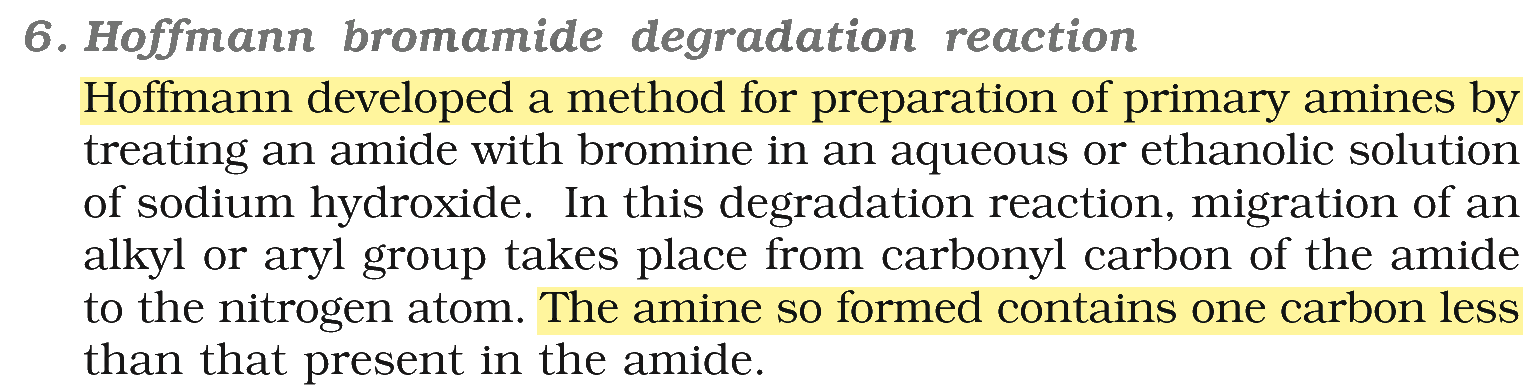
An amide is converted into a primary amine with one carbon atom less by heating it with bromine in aqueous (or ethanolic) sodium hydroxide. This is the Hofmann bromamide degradation; the carbonyl carbon is lost as carbonate. Benzamide gives aniline in a single step:
\( \ce{C6H5CONH2 + Br2 + 4NaOH -> C6H5NH2 + Na2CO3 + 2NaBr + 2H2O} \)
Why the other options are incorrect
Option (1) NaNO2 + dil. HCl at 0°C — Incorrect. This is the reagent for diazotisation; it converts aniline into benzenediazonium chloride, the reverse direction from what is needed.
Option (2) I2 + aq. NaOH — Incorrect. This is the iodoform reagent, used to detect \( \ce{CH3CO} \)– groups; the Hofmann degradation needs bromine.
Option (4) Br2 + CH3COOH — Incorrect. Bromine in acetic acid brominates activated aromatic rings (for example acetanilide to p-bromoacetanilide); it does not remove the carbonyl carbon from an amide.
NCERT (2026-27 edition):
Hoffmann Bromamide Degradation Reaction