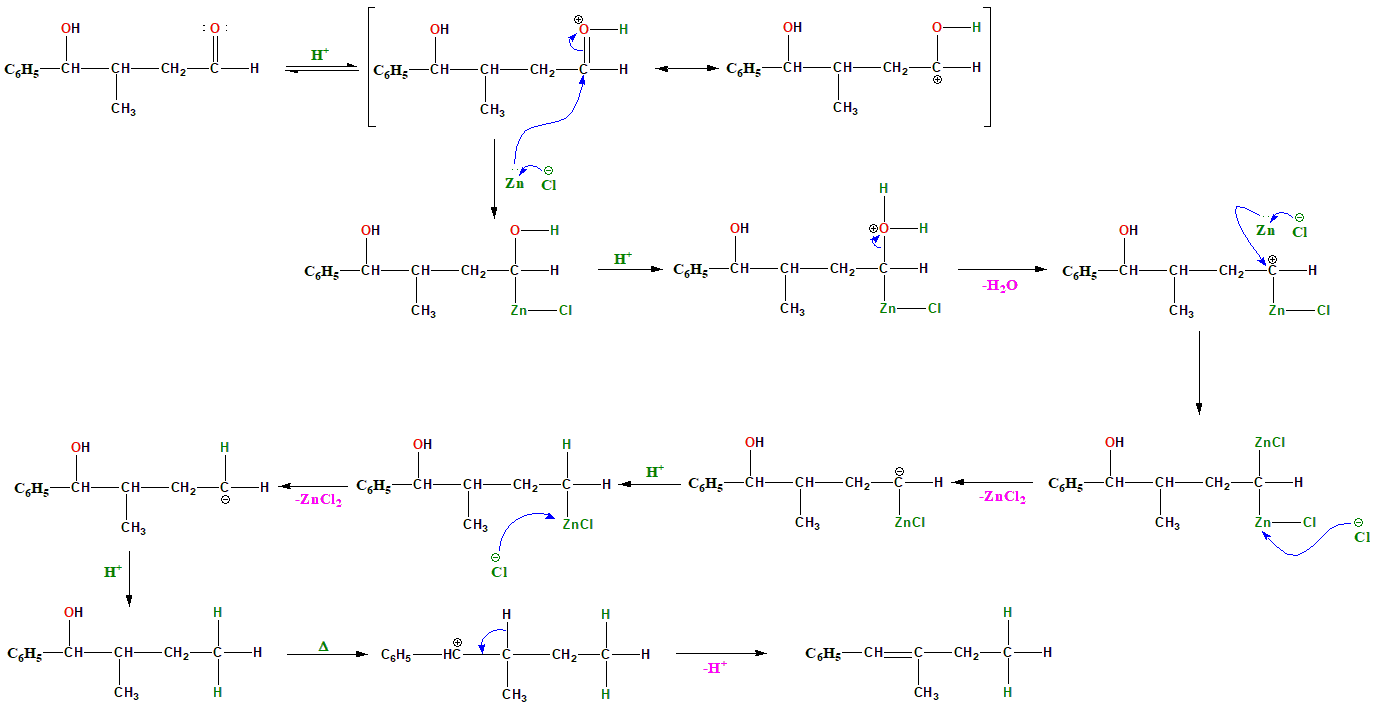
Aldehydes are generally more reactive than ketones in nucleophilic addition reactions due to steric and electronic reasons. Sterically, the presence of two relatively large substituents in ketones hinders the approach of nucleophile to carbonyl carbon than in aldehydes having only one such substituent. ELectronically, aldehydes are more recative than ketones because two alkyl groups reduce the electrophilicity of teh carbonyl more efficiently than in former.
The major product formed in the following reaction is
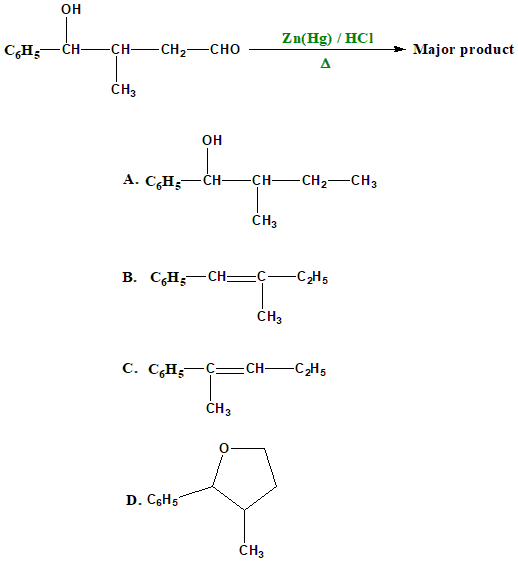
Choose the correct answer from the options given below:
Answer & explanation
Correct answer: option 2
The correct answer is option 2. B only
The given reaction is Clemmensen reduction.The Clemmensen reduction is a reaction that is used to reduce aldehydes or ketones to alkanes using hydrochloric acid and zinc amalgam. The Clemmensen reduction is named after a Danish chemist, Erik Christian Clemmensen. This reaction is particularly effective in aryl-alkyl ketones reduction formed in Friedel-Crafts acylation. The reaction is more effective in reduction of cyclic ketones or aliphatic and zinc metal.
So, the given reaction can be written as:
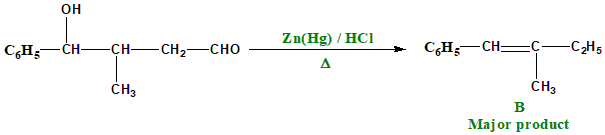
Mechanism:
Firstly the reaction undergoes Clemmensen reduction followed by heating which leads to dehydration.