
The following statements describe various properties of a Mercury cell:
(A) It converts energy of combustion into electrical energy
(B) It is rechargeable
(C) The cell reaction involved is \( Zn(Hg) + HgO(s) → ZnO(s) + Hg(l) \)
(D) It is a low current device used in hearing aids
Choose the correct answer from the options given below:
Answer & explanation
Correct answer: option 4
The correct answer is Option (4) → (C) and (D) only
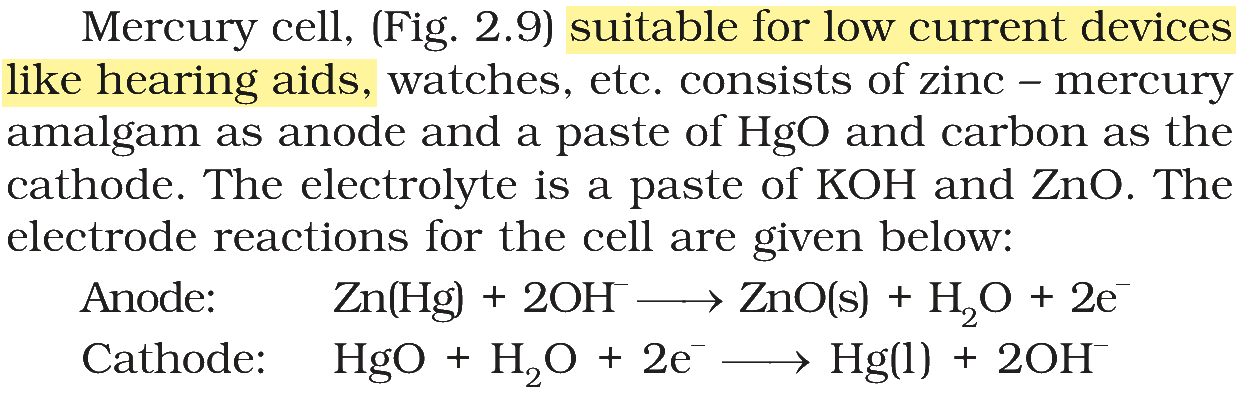
The mercury cell is a primary cell. Its anode is a zinc–mercury amalgam, its cathode a paste of HgO and carbon, and its electrolyte a paste of KOH and ZnO:
\( \displaystyle \text{Anode: } \ce{Zn(Hg) + 2OH- -> ZnO(s) + H2O + 2e-} \)
\( \displaystyle \text{Cathode: } \ce{HgO(s) + H2O + 2e- -> Hg(l) + 2OH-} \)
\( \displaystyle \text{Cell reaction: } \ce{Zn(Hg) + HgO(s) -> ZnO(s) + Hg(l)} \)
No ion appears in the cell reaction, so its potential stays constant (about 1.35 V) throughout its life.
(A) It converts energy of combustion into electrical energy — Incorrect. This describes a fuel cell; the mercury cell uses a redox reaction between zinc and mercury(II) oxide.
(B) It is rechargeable — Incorrect. It is a primary cell; once the reactants are used up it cannot be recharged.
(C) The cell reaction involved is \( \ce{Zn(Hg) + HgO(s) -> ZnO(s) + Hg(l)} \) — Correct. This is the cell reaction above.
(D) It is a low current device used in hearing aids — Correct. It is used in low current devices such as hearing aids and watches.
NCERT (2026-27 edition):
Primary Batteries – …
“The overall reaction is represented by
\( \ce{Zn(Hg) + HgO(s) -> ZnO(s) + Hg(l)} \)”