The downward movement along the demand curve of a commodity is due to:
Choose the correct option.
Answer & explanation
Correct answer: option 4
The correct answer is Option (4) → Decrease in the price of the commodity demanded
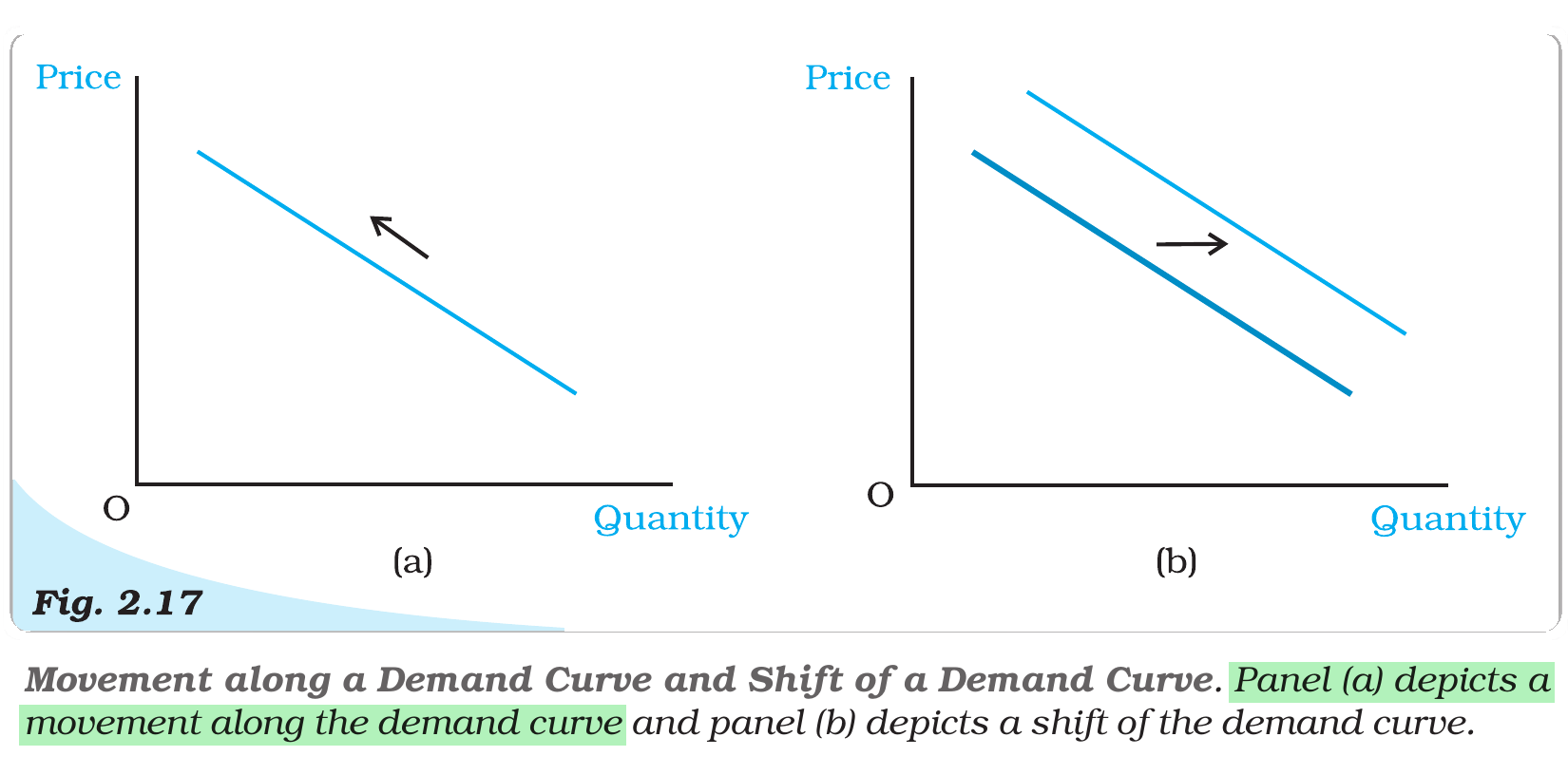
A change in the price of the good itself leads to a movement along its demand curve. A lower price means a move down the curve. A change in anything else shifts the whole curve.
Option (1) Decrease in income tax — Incorrect. A lower income tax leaves the consumer with more income. A change in income shifts the demand curve.
Option (2) Decrease in the income of the consumer — Incorrect. For a normal good, a fall in income shifts the curve to the left.
Option (3) Decrease in the price of its substitute — Incorrect. A substitute is a good used in place of another, like tea and coffee. When it becomes cheaper, people buy less of this good at each price, so the curve shifts to the left.
Option (4) Decrease in the price of the commodity demanded — Correct. Other things remain the same. At a lower price the consumer buys more, which is a move down the same curve.
NCERT (2026-27): “Demand Curve … As it has been noted earlier, the amount of a good that the consumer chooses depends on the price of the good, the prices of other goods, income of the consumer and her tastes and preferences. The demand function is a relation between the amount of the good and its price when other things remain unchanged. The demand curve is a graphical representation of the demand function. At higher prices, the demand is less, and at lower prices, the demand is more. Thus, any change in the price leads to movements along the demand curve. On the other hand, changes in any of the other things lead to a shift in the demand curve. Figure 2.17 illustrates a movement along the demand curve and a shift in the demand curve.”
|