
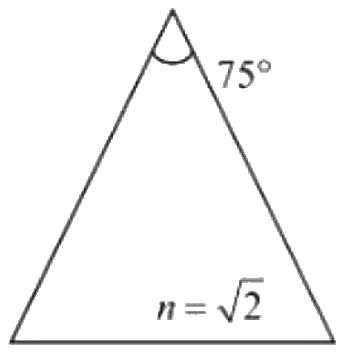
Maximum angle of deviation of a prism having refractive index \( \sqrt{2} \) and angle of prism \( 75^\circ \) will be
Answer & explanation
Correct answer: option 3
The correct answer is Option (3) → \( \displaystyle\frac{\pi}{3} \)
The deviation is least at minimum deviation and grows towards either end of the allowed range of incidence, so it is maximum at grazing incidence (\( i = 90^\circ \)), or equally at grazing emergence. For a prism, \( r_1 + r_2 = A \) and \( \delta = i + e - A \).
Putting \( i = 90^\circ \) in Snell's law at the first face:
\( \displaystyle \sin r_1 = \frac{\sin 90^\circ}{\sqrt{2}} = \frac{1}{\sqrt{2}} \;\Rightarrow\; r_1 = 45^\circ \)
\( r_2 = A - r_1 = 75^\circ - 45^\circ = 30^\circ \)
At the second face:
\( \displaystyle \sin e = \sqrt{2}\,\sin 30^\circ = \frac{\sqrt{2}}{2} = \frac{1}{\sqrt{2}} \;\Rightarrow\; e = 45^\circ \)
\( \delta_{\max} = i + e - A = 90^\circ + 45^\circ - 75^\circ = 60^\circ \)
\( \displaystyle \delta_{\max} = 60^\circ = \frac{\pi}{3} \)
For comparison, the minimum deviation here is only about \( 43.8^\circ \), so \( 60^\circ \) is indeed the largest deviation.