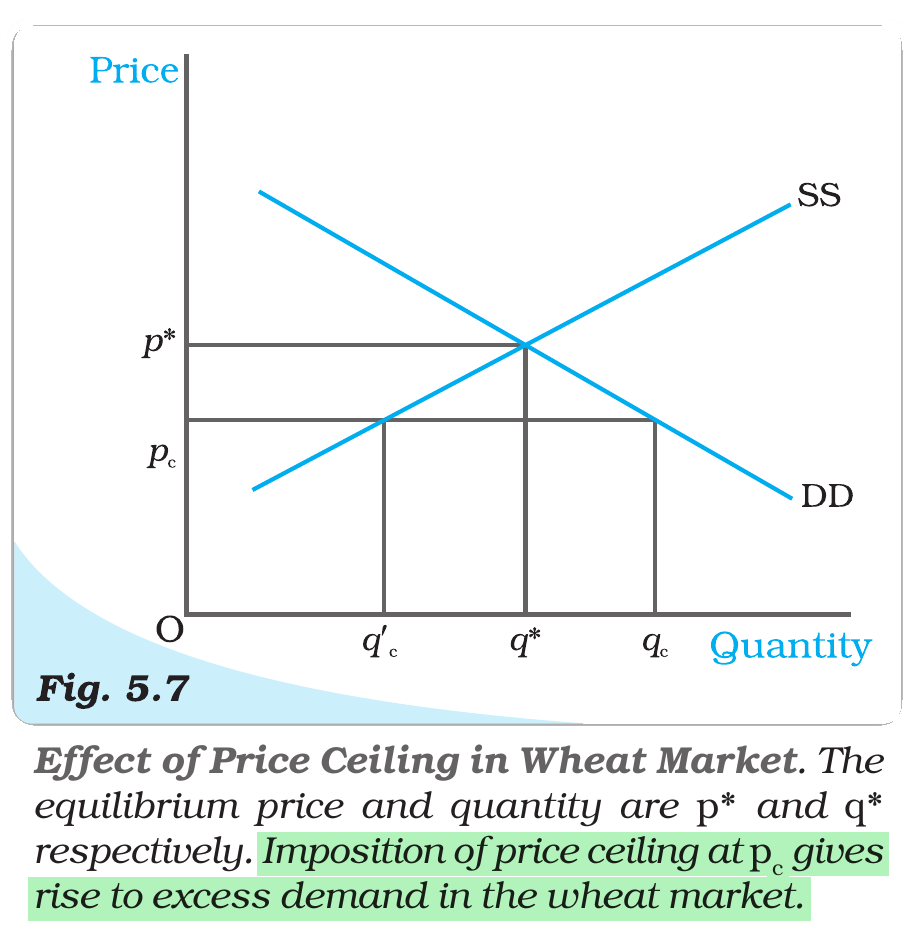
What would price ceiling lead to when the maximum price is fixed lower than the equilibrium price?
Answer & explanation
Correct answer: option 3
The correct answer is Option (3) → Excess Demand.
A price ceiling is an upper limit on price set by the government. When it is below the equilibrium price, buyers want more of the good and sellers offer less. So market demand is greater than market supply, which is excess demand.
This creates a shortage of the good. ‘Deficit supply’ is not a standard term; economics calls this gap excess demand. Excess supply comes from the opposite case, a price floor set above the equilibrium price.
Note: A same/similar question was asked in CUET (UG) in the papers below.
| 2026 | 2025 | 2024 | 2023 | 2022 |
| 12-05 S1* | 02-06 S1 | – | – | – |
* A similar question.
NCERT (2026-27): “5.2.1 Price Ceiling It is not very uncommon to come across instances where government fixes a maximum allowable price for certain goods. The government-imposed upper limit on the price of a good or service is called price ceiling. Price ceiling is generally imposed on necessary items like wheat, rice, kerosene, sugar and it is fixed below the market-determined price since at the market-determined price some section of the population will not be able to afford these goods.… …Figure 5.7 shows the market supply curve SS and the market demand curve DD for wheat. The equilibrium price and quantity of wheat are p* and q* respectively. When the government imposes price ceiling at pc which is lower than the equilibrium price level, there will be an excess demand for wheat in the market at that price.… …… The market equilibrium here would occur at price p* and quantity q*. But when the government imposes a floor higher than the equilibrium price at pf , the market demand is qf whereas the firms want to supply qf′, thereby leading to an excess supply in the market equal to qfqf′.”
|