
A manufacturer produces two Models of bikes - Model X and Model Y. Model X takes a 6 man-hours to make per unit, while Model Y takes 10 man- hours per unit. There is a total of 450 man-hour available per week. Handling and Marketing costs are Rs 2000 and Rs 1000 per unit for Models X and Y respectively. The total funds available for these purposes are Rs 80,000 per week. Profits per unit for Models X and Y are Rs 1000 and Rs 500, respectively. How many bikes of each model should the manufacturer produce so as to yield a maximum profit? Find the maximum profit.
Answer & explanation
Correct answer: option 1
The correct answer is Option (1) → Model X: 25, Model Y: 30; Max Profit: Rs 40,000
Let x and y be the number of Models of bike produced by the manufacturer. Given information is
Model X takes 6 man-hours to make per unit
Model Y takes 10 man-hours to make per unit
Total man-hours available = 450
$∴6x + 10y ≤ 450⇒3x+5y≤ 225$ ...(i)
Handling and marketing cost of Model X and Y are ₹2,000 and ₹1,000 respectively
Total funds available is ₹80,000 per week
$∴2000x + 1000y ≤ 80,000$
$⇒2x + y ≤ 80$ ...(ii)
and $x ≥80, y ≥0$
Profit (Z) per unit of models X and Y are ₹1,000 and ₹500 respectively
So, $Z = 1000x + 500y$
The required LPP is Maximise $Z = 1000x + 500y$ subject to the constraints
$3x+5y≤225$ ...(i)
|
x |
0 |
75 |
|
y |
45 |
0 |
$2x + y ≤ 80$ ...(ii)
|
x |
0 |
40 |
|
y |
80 |
0 |
$x≥0, y ≥0$ ...(iii)
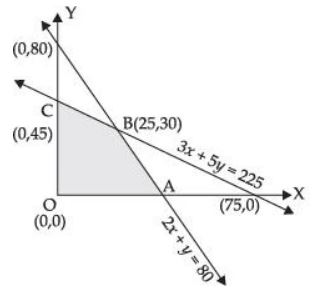
On solving eq. (i) and (ii) we get, $x = 25, y = 30$
Here, the feasible region is OABC, whose corner points are
$O(0, 0), A(40, 0), B(25, 30)$ and $C(0, 45)$.
Let us evaluate the value of Z.
|
Corner points |
Value of $Z=1000x + 500y$ |
|
O(0, 0) |
$Z=0+0=0$ |
|
A(40, 0) |
$Z=1000(40)+0=40,000$ ← Maximum |
|
B(25, 30) |
$Z=1000(25)+500(30)=40,000$ ← Maximum |
|
C(0,45) |
$Z=0+500(45) = 22500$ |
Hence, the maximum profit is ₹40,000 by producing 25 bikes of Model X and 30 bikes of Model Y.