
A furniture trader deals in only two items- chairs and tables. He has ₹50000 to invest and a space to store atmost 35 items. A chair costs him ₹1000 and a table costs him ₹2000. The trader earns a profit of ₹150 and ₹250 on a chair and a table, respectively. Formulate the above problem as an L.P.P. to maximise the profit and solve it graphically.
Answer & explanation
Correct answer: option 3
The correct answer is Option (3) → Maximum Profit: ₹6750, by buying 20 chairs and 15 tables.
Let x be the number of chairs and y be the number of tables that the dealer buys and sells. The profit on a chair is ₹150 and the profit on a table is ₹250. So, total profit $P = 150x + 250y$. Hence, the problem can be formulated as an L.P.P. as follows:
Maximise $P = 150x + 250y$ subject to the constraints
$x + y ≤35$ (storage constraint)
$1000x + 2000y ≤ 50000$
i.e. $x+2y≤50$ (investment constraint)
$x ≥ 0, y ≥ 0$ (non-negativity constraints)
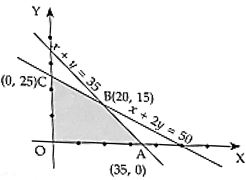
Draw the lines $x+y=35$ and $x + 2y = 50$; shade the region satisfied by the given inequalities. The shaded portion shows the feasible region which is bounded. The point of intersection of the lines $x + y = 35$ and $x + 2y = 50$ is B(20, 15).
The four corner points of the feasible region OABC are O(0, 0), A(35, 0), B(20, 15) and C(0, 25).
At $(0, 0), P = 150 × 0 + 250 × 0 = 0$
At $A(35, 0), P = 150 × 35+ 250 × 0 = 5250$
At $B(20, 15), P = 150 × 20 + 250 × 15 = 6750$.
At $C(0, 25), P = 150 × 0 + 250 × 25 = 6250$.
We find that P is maximum at B(20, 15) and maximum value of P = 6750.
Hence, the dealer gets maximum profit of ₹6750 when he buys and sells 20 chairs and 15 tables.