
CUETMOCK
  • Pricing
  • Mentors
Log inStart freeStart free mocks→

First test, then trust

Try a free CUET mock test.

Join 5,00,000+ students who rehearsed exam day on the exact NTA screen before sitting CUET. On the web and on Android.

Start free mocks →Get the Android app
CUETMOCK

India's #1 CUET Mock Test Platform. Original NCERT-based questions on the exact NTA exam screen — trusted by 5,00,000+ students since CUET 2022.

Get it onGoogle PlayScan to download the CUETMOCK app

Mock tests

  • CUET mock test series
  • Browse all papers
  • Commerce mocks
  • Humanities (Arts) mocks
  • Science mocks
  • Languages & GAT mocks
  • Free practice questions
  • Pricing

Resources

  • CUET exam guide
  • CUET syllabus
  • Universities accepting CUET
  • Expert blogs
  • News & notifications
  • Webinars & counselling
  • CUET score calculator
  • How we estimate your rank
  • FAQs

Company

  • About us
  • Our leadership & team
  • Our toppers
  • Mentors
  • For schools
  • Contact us
  • Terms
  • Privacy
  • Refund policy

Talk to us

+91 7696 6630 56info@cuetmock.comWhatsApp us

Our other platforms

  • JEE Mock — For IIT-JEE aspirants
  • NEET Mock — For NEET aspirants

Newsletter

Exam updates, study material and offers — no spam.

© 2026 NYC Ventures Pvt. Ltd.

701-702, Royal Business Park, Zirakpur, Punjab - 140603

  • Terms of use
  • Privacy policy
  • Refund policy
  • Contact us

iCUETMOCK is an independent preparation platform, not affiliated with the National Testing Agency (NTA). Always check exam details on the official NTA website.

  • Home
  • Mock tests
  • CUET guide
  • Pricing
  • Log in
Home/Practice questions/Biology
BiologyOrganisms and Populations

In Verhulst Pearl logistic growth curve equation, dN/dt = rN≤ft((K-N)…

In Verhulst Pearl logistic growth curve equation, \( \displaystyle \frac{dN}{dt} = rN\left(\frac{K-N}{K}\right) \), ‘r’ refers to:

Answer & explanation+

Correct answer: option 3

The correct answer is Option (3) → Intrinsic rate of natural increase

In this equation, dN/dt is the rate at which the population grows. The factor (K − N)/K slows the growth as the population comes close to the carrying capacity.

Option (1) Population density at time t — Incorrect. The population density at time t is written as N, not r.

Option (2) Population density at time Zero — Incorrect. The starting density is written as N0. It appears in the integral form of exponential growth, Nt = N0ert, not in this equation.

Option (3) Intrinsic rate of natural increase — Correct. r is the birth rate minus the death rate per individual (r = b − d). It is the population’s own power to grow, and it is used to judge how any factor affects growth.

Option (4) Carrying capacity — Incorrect. The carrying capacity is K, the largest population the habitat can support.

Note: The same question was also asked in CUET (UG) 2026 on 29-05-2026 (Slot 2), and a similar question in CUET (UG) 2026 on 19-05-2026 (Slot 1).

NCERT Extract:
Population Growth – “… In nature, a given habitat has enough resources to support a maximum possible number, beyond which no further growth is possible. Let us call this limit as nature’s carrying capacity (K) for that species in that habitat. A population growing in a habitat with limited resources show initially a lag phase, followed by phases of acceleration and deceleration and finally an asymptote, when the population density reaches the carrying capacity. A plot of N in relation to time (t) results in a sigmoid curve. This type of population growth is called Verhulst-Pearl Logistic Growth (Figure 11.3) and is described by the following equation:
\( \displaystyle \frac{dN}{dt} = rN\left(\frac{K-N}{K}\right) \)
Where
N = Population density at time t
r = Intrinsic rate of natural increase
K = Carrying capacity Since resources for growth for most animal populations are finite and become limiting sooner or later, the logistic growth model is considered a more realistic one.”
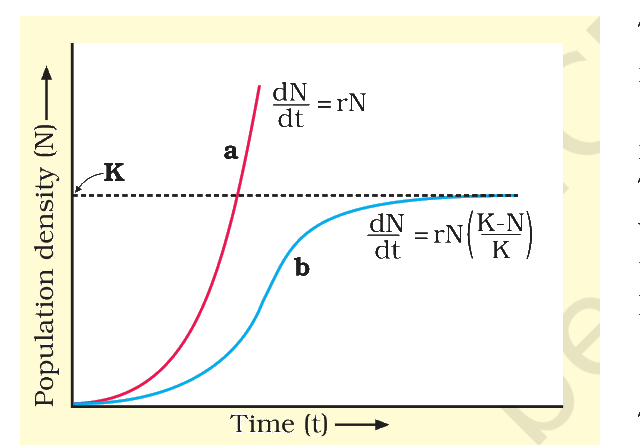
Textbook figure

Figure 11.3 Population growth curve a when responses are not limiting the growth, plot is exponential, b when responses are limiting the growth, plot is logistic, K is carrying capacity

Advertisement

Practise more on Organisms and Populations

Chapter-wise mocks on the real NTA exam screen, with solutions and your rank. Your first mocks are free.

Start free mocks →

Advertisement

Next questions

  1. Select the most appropriate meaning of the given idiom. Give cold shoulderEnglish · Grammar: Idioms
  2. What is the ratio of amplitude of magnetic field to the amplitude of electric field for an electromagnetic wave propagating in vacuum?Physics · Electromagnetic Waves
  3. Which special advantages contribute to a higher value of goodwill?Accountancy Part A · Admission of a Partner
  4. Study the following arrangement carefully and answer the question given below:R D A K 7 B I 3 M J E N 6 7 U Z V 1 W 3 H 4 F Y 8 P 6How many…General Aptitude Test · Verbal Reasoning
  5. Choose the correct option to fill in the blank in the given sentence:She could not bring herself to forget how mean Ravi was to her sister.…English · Fill Blanks
  6. Choose the missing number (?) from given alternatives.7493439817296?216General Aptitude Test · Verbal Reasoning
  7. Which of the following hormones is not involved in parturition?Biology · Human Reproduction
  8. In the following question find out the alternative which will replace the question mark. hot : warm :: happy : ?English · Analogy
  9. Match the words given in List I with their Antonyms given in List II LIST I LIST II A. Popular I. Stop B. Proceed II. Reject C. Blessing II…English · Antonyms
  10. Select the option that can be used as a one-word substitute for the given group of words. A person who held a job or office before the curr…English · One Word