
Two identical thin rings each of radius R are coaxially placed at a distance R. If the rings have a uniform mass distribution and each has mass m1 and m2 respectively, then the work done in moving a mass m from centre of one ring to that of the other is
Answer & explanation
Correct answer: option 2
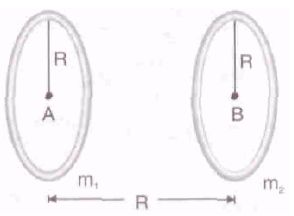
$V_{A}=\left(\begin{array}{c}
\text { Potential at } \\
\text { A due to } A
\end{array}\right)+\left(\begin{array}{c}
\text { Potential at } \\
\text { A due to B }
\end{array}\right)$
$\Rightarrow V_{\mathrm{A}}=-\frac{\mathrm{Gm}_1}{\mathrm{R}}-\frac{\mathrm{Gm}_2}{\sqrt{2} \mathrm{R}}$ and
Similarly,
$V_B=\left(\begin{array}{c} \text { Potential at } \\ B \text { due to } A \end{array}\right)+\left(\begin{array}{c}
\text { Potential at } \\
B \text { due to B } \end{array}\right)$
Since $W_{A \rightarrow B}=m\left(V_B-V_A\right)$
$\Rightarrow W_{A \rightarrow B}=\frac{G m\left(m_1-m_2\right)(\sqrt{2}-1)}{\sqrt{2} R}$