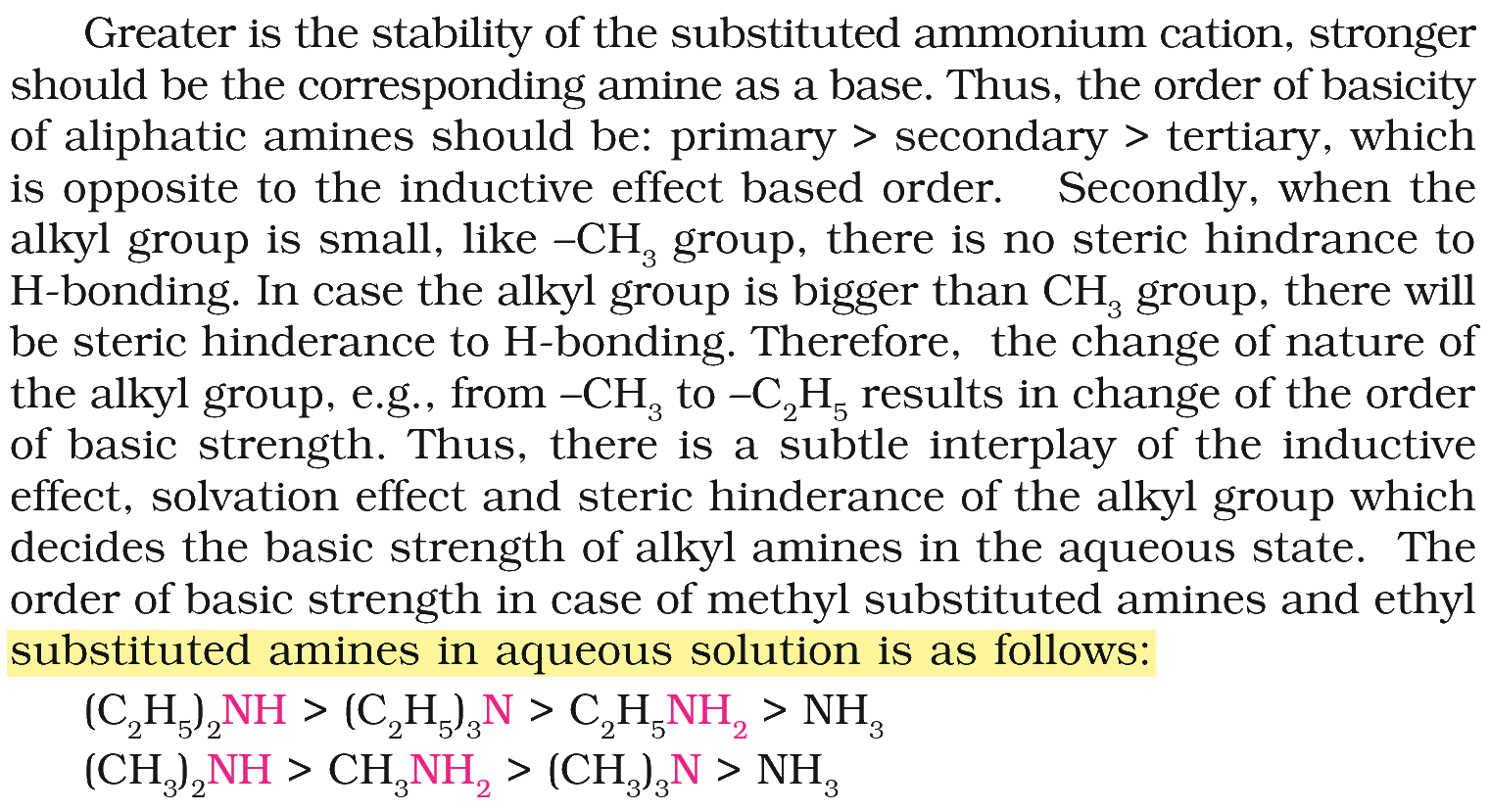
The correct order of increasing basicity in aqueous medium for
(I) \(NH_3\) (II) \(CH_3CH_2NH_2\) (III) \((CH_3CH_2)_2NH\) (IV) \((CH_3CH_2)_3N\)
(A) (II) < (I) < (IV) < (III)
(B) (II) < (I) < (III) < (IV)
(C) (I) < (II) < (IV) < (III)
(D) (I) > (II) > (IV) > (III)
Choose the correct answer from the options given below:
Answer & explanation
Correct answer: option 1
The correct answer is Option (1) → (C)
In the gas phase alkyl groups raise the basic strength by their +I effect, giving 3° > 2° > 1° > \( \ce{NH3} \). In water two more factors act: solvation of the substituted ammonium ion by hydrogen bonding (more N–H bonds, better solvation and more stable ion) and steric hindrance of the alkyl groups to the approach of \( \ce{H^{+}} \).
(III) (CH3CH2)2NH: two ethyl groups for +I effect, and its ion still has two N–H bonds for solvation: strongest.
(IV) (CH3CH2)3N: the largest +I effect, but its ion has only one N–H bond and the three ethyl groups crowd the nitrogen; with ethyl groups the +I effect still keeps it above the primary amine.
(II) CH3CH2NH2: one ethyl group; well solvated but the smallest +I effect of the three amines.
(I) NH3: no alkyl group: weakest.
NCERT (2026-27 edition):
Alkanamines versus Ammonia – “… In the aqueous phase, the substituted ammonium cations get stabilised not only by electron releasing effect of the alkyl group (+I) but also by solvation with water molecules. The greater the size of the ion, lesser will be the solvation and the less stabilised is the ion.”