
Observe the diagram and answer the question.
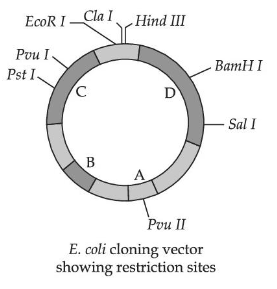
Match List - I with List - II.
|
List – I |
List – II |
|
(A) $ori$ |
(I) D |
|
(B) $tet^R$ |
(II) B |
|
(C) $rop$ |
(III) C |
|
(D) $amp^R$ |
(IV) A |
Choose the correct answer from the options given below:
Answer & explanation
Correct answer: option 3
The correct answer is Option (3) → (A)-(II), (B)-(I), (C)-(IV), (D)-(III)
|
List – I |
List – II |
|
(A) $ori$ |
(II) B |
|
(B) $tet^R$ |
(I) D |
|
(C) $rop$ |
(IV) A |
|
(D) $amp^R$ |
(III) C |
In order to link the alien DNA, the vector needs to have very few, preferably single, recognition sites for the commonly used restriction enzymes. Presence of more than one recognition sites within the vector will generate several fragments, which will complicate th gene cloning. The ligation of alien DNA is carried out at a restriction site present in one of the two antibiotic resistance genes. For example, we can ligate a foreign DNA at the BamH I site of tetracycline resistance gene in the vector pBR322. The recombinant plasmids will lose tetracycline resistance due to insertion of foreign DNA.
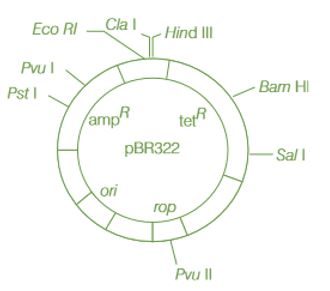
E. coli cloning vector pBR322 showing restriction sites (Hind III, EcoR I, BamH I, Sal I, Pvu II, Pst I, Cla I), ori and antibiotic resistance genes (ampR and tetR). rop codes for the proteins involved in the replication of the plasmid.