Read the following passage and answer the next five questions:
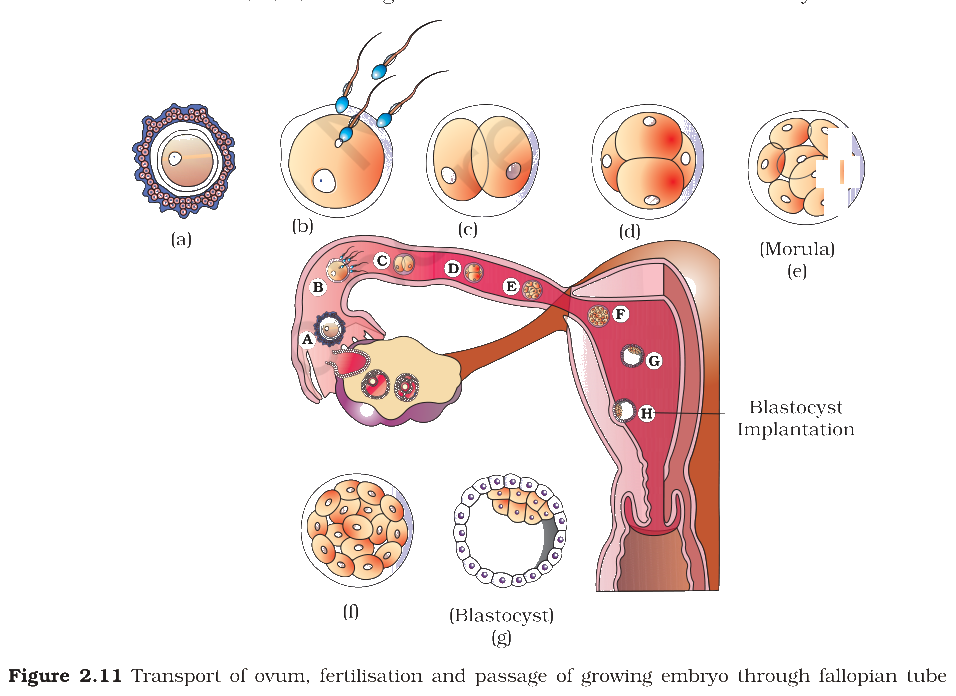
The reproductive cycle of female primates is called menstrual cycle. Menstrual cycle starts only after attaining sexual maturation (puberty). Generally, during ovulation only one ovum is released per menstrual cycle. The cyclical changes in the ovary and the uterus during menstrual cycle are induced by changes in the levels of pituitary and ovarian hormones. After coitus, sperms are transported to the junction of the isthmus and ampulla, where the sperm fertilises the ovum leading to formation of a diploid zygote.
Select the organ of female reproductive system where the sperm is not transported at the time of coitus:
Answer & explanation
Correct answer: option 2
The correct answer is Option (2) → Ovary
Option (1) Cervix — Sperms are transported through it. The semen is released into the vagina, and the sperms swim through the cervix first.
Option (2) Ovary — Sperms are not transported to it. The ovary is the female gonad that releases the ovum. It is not part of the sperms’ path. The ovum leaves the ovary, and the sperms meet it in the ampullary region of the fallopian tube.
Option (3) Uterus — Sperms are transported through it. From the cervix the sperms enter the uterus and move up through it.
Option (4) Fallopian tube — Sperms are transported through it. The sperms finally reach the junction of the isthmus and ampulla of the fallopian tube, where fertilisation takes place.
Note: This passage is taken from NCERT as it is. Most CUET (UG) questions come straight from NCERT, so study the book line by line, including figures and their titles.
NCERT Extract:
Fertilisation and Implantation – “… During copulation (coitus) semen is released by the penis into the vagina (insemination). The motile sperms swim rapidly, pass through the cervix, enter into the uterus and finally reach the ampullary region of the fallopian tube (Figure 2.11b). The ovum released by the ovary is also transported to the ampullary region where fertilisation takes place.”