
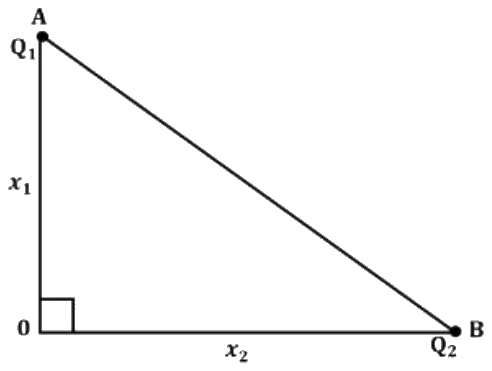
AOB is a right angled triangle. Charges \( Q_1 \) and \( Q_2 \) are placed as shown. If the resultant electric field at O is perpendicular to the hypotenuse then \( Q_1/Q_2 \) is proportional to:
Answer & explanation
Correct answer: option 1
The correct answer is Option (1) → \( x_1/x_2 \)
The field at O is the vector sum of the field of \( Q_1 \) (along OA, magnitude \( kQ_1/x_1^{2} \)) and the field of \( Q_2 \) (along OB, magnitude \( kQ_2/x_2^{2} \)). These two are at right angles.
Take O as origin, OB along the x-axis and OA along the y-axis. The hypotenuse AB has direction \( (x_2, -x_1) \). The resultant is perpendicular to AB, so its dot product with AB is zero. With both charges of the same sign, the field components at O are \( (-E_2, -E_1) \), where \( E_1 = kQ_1/x_1^{2} \) and \( E_2 = kQ_2/x_2^{2} \):
\( \displaystyle -E_2\,x_2 + E_1\,x_1 = 0 \;\Rightarrow\; \frac{kQ_1}{x_1^{2}}\,x_1 = \frac{kQ_2}{x_2^{2}}\,x_2 \)
\( \displaystyle \frac{Q_1}{x_1} = \frac{Q_2}{x_2} \;\Rightarrow\; \frac{Q_1}{Q_2} = \frac{x_1}{x_2} \)