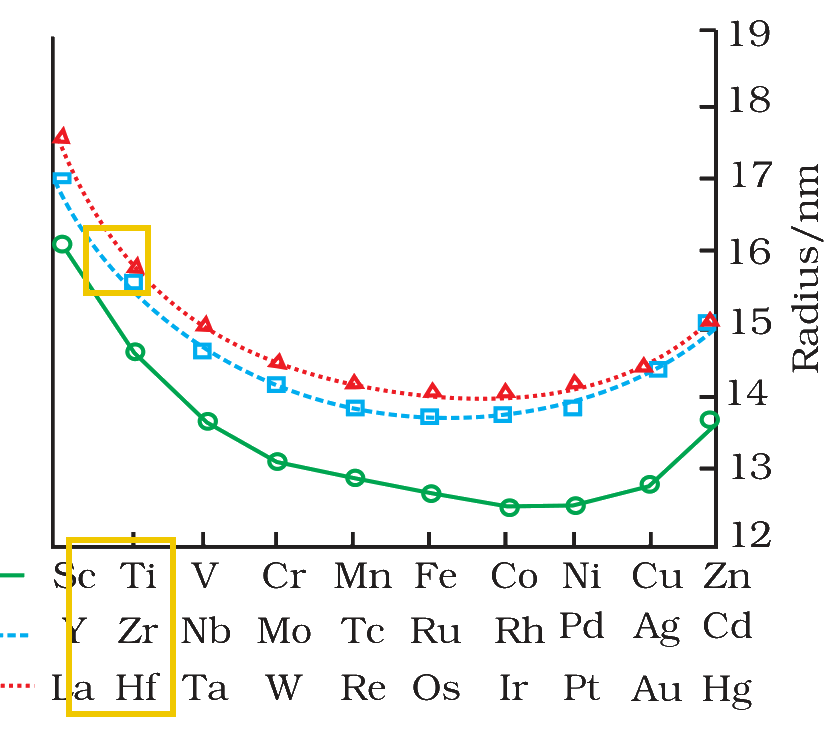
The atomic radii of Zr and Hf are similar. This is because:
Answer & explanation
Correct answer: option 2
The correct answer is Option (2) → of Lanthanoid contraction
Normally atomic radius increases down a group. Zr is in the 4d series and Hf in the 5d series, but before the 5d series begins, the 4f subshell is filled in the lanthanoids (Ce to Lu). The 4f electrons shield the nuclear charge poorly, so the atomic and ionic radii shrink steadily across the lanthanoids: this is the lanthanoid contraction.
This decrease almost completely cancels the increase expected from Zr to Hf, so their radii are nearly the same (Zr 160 pm, Hf 159 pm) and their chemistry is very similar.
Why the other options are incorrect
Option (1) of Actinoid contraction — Incorrect. The actinoids come after Hf in the periodic table, so they cannot affect it.
Option (3) they lie in same period — Incorrect. Zr is in period 5 and Hf in period 6.
Option (4) they lie in same group — Incorrect. They are both in group 4, but being in the same group usually means the lower element is larger.
NCERT (2026-27 edition):
Variation in Atomic and Ionic Sizes of Transition Metals – “… An interesting point emerges when atomic sizes of one series are compared with those of the corresponding elements in the other series. The curves in Fig. 4.3 show an increase from the first (3d) to the second (4d) series of the elements but the radii of the third (5d) series are virtually the same as those of the corresponding members of the second series. This phenomenon is associated with the intervention of the 4f orbitals which must be filled before the 5d series of elements begin. The filling of 4f before 5d orbital results in a regular decrease in atomic radii called Lanthanoid contraction which essentially compensates for the expected increase in atomic size with increasing atomic number. The net result of the lanthanoid contraction is that the second and the third d series exhibit similar radii (e.g., Zr 160 pm, Hf 159 pm) and have very similar physical and chemical properties much more than that expected on the basis of usual family relationship.”