What is the defense mechanism adopted by Acacia and Cactus to protect themselves from predators (herbivores)?
Answer & explanation
Correct answer: option 3
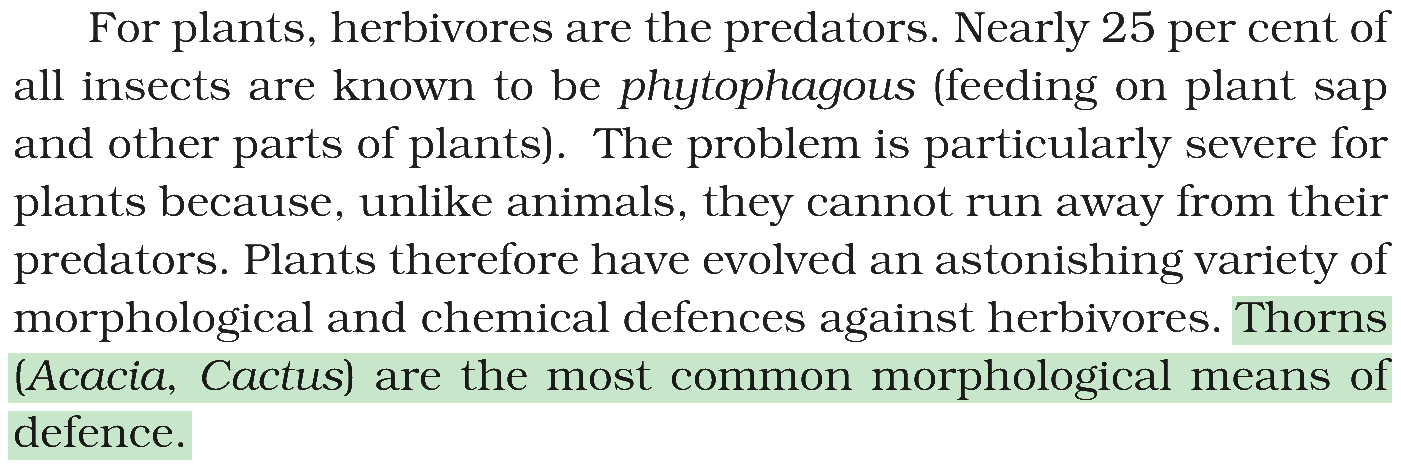
The correct answer is Option (3) → Thorns
For plants, herbivores are the predators, and a plant cannot run away from them. So plants have evolved morphological defences (parts of the body) and chemical defences (poisons and bad-tasting chemicals) against herbivores.
Option (1) Fleshy stem — Incorrect. A fleshy stem, as in Opuntia, stores water and makes food in a dry habitat. It is an adaptation to drought, not a defence against animals.
Option (2) Dry habitat — Incorrect. A dry habitat is the place where the plant lives, not something the plant does to protect itself.
Option (3) Thorns — Correct. Sharp thorns keep grazing animals away. They are the commonest morphological defence. A chemical defence works differently: Calotropis, for example, makes highly poisonous cardiac glycosides, so cattle do not browse on it.
Option (4) Rough texture — Incorrect. A rough surface is not one of the defences the book names for Acacia and cactus. Their defence is the thorn.
NCERT Extract:
Population Interactions – …