Read the given paragraph carefully and answer the following questions.
Total Product, Average Product and Marginal Product
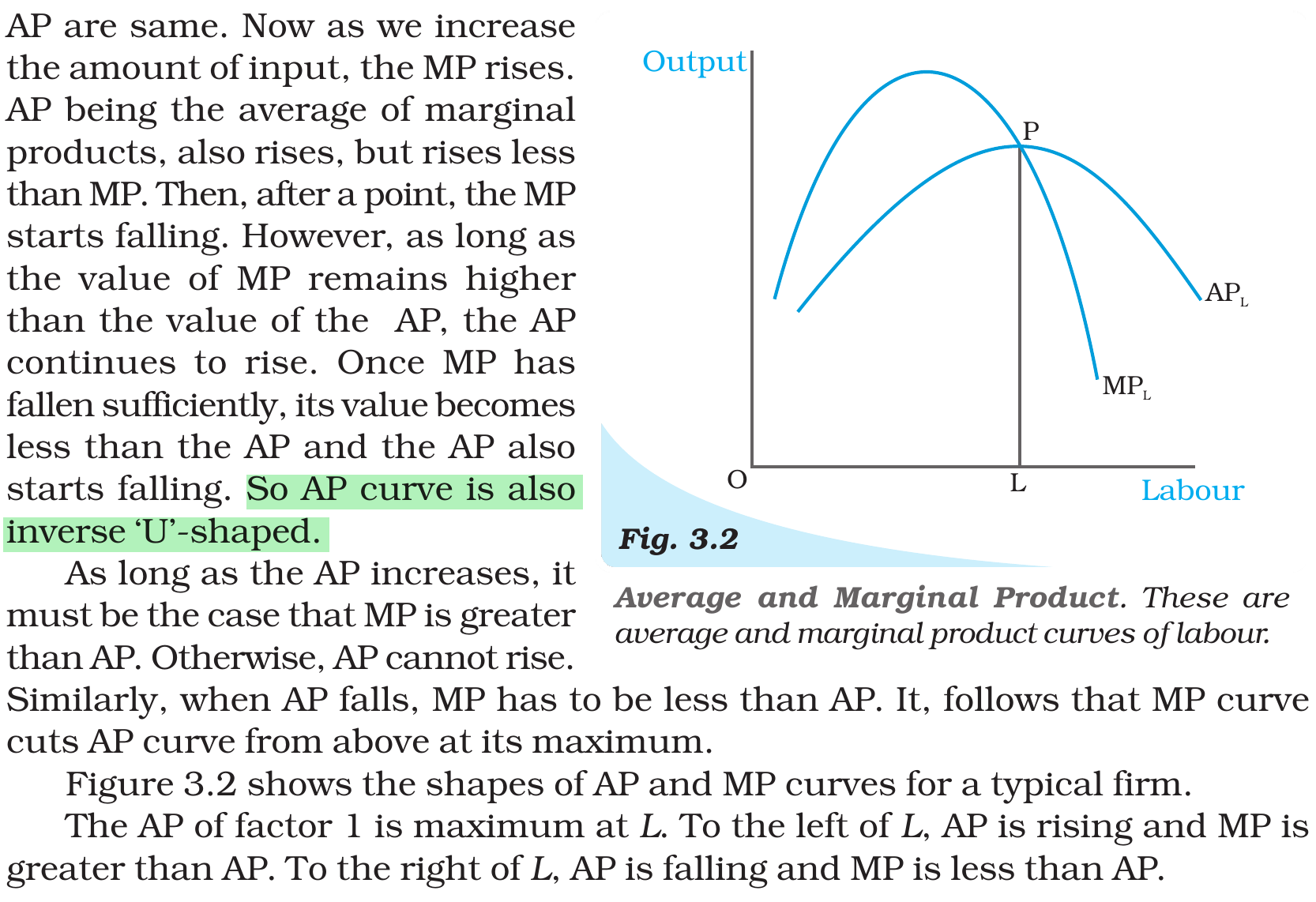
The relationship between the variable input and output, keeping all other inputs constant, is often referred to as total product (TP) of the variable input. Average product (AP) is defined as the output per unit of variable input. Marginal product (MP) of an input is defined as the change in output per unit of change in the input when all other inputs are held constant. According to the law of variable proportions, the marginal product of an input initially rises and then, after a certain level of employment, it starts falling. As long as AP increases, it must be the case that MP is greater than AP. Otherwise, AP cannot rise. Similarly, when AP falls, MP has to be less than AP. It follows that MP curve cuts AP curve from above at its maximum.
The shape of the average product and marginal product curves are .......
Answer & explanation
Correct answer: option 1
The correct answer is Option (1) → Both Inverse 'U' Shaped
The curves of average product (AP) and marginal product (MP) are both inverse ‘U’-shaped. Each first rises, reaches a maximum and then falls.
By the law of variable proportions, MP first rises and then starts falling. AP keeps rising as long as MP is above it. Once MP falls below AP, AP falls too. The ‘U’ shape belongs to cost curves, such as the average cost curve.
NCERT (2026-27): Introductory Microeconomics — Chapter 3: Production and Costs
|