
Read the passage carefully and answer.
The molar conductivity of a solution at any given concentration is the conductance of the volume of solution containing one mole of electrolyte kept between two platinum electrodes with unit area of cross-section and at a distance of unit length. Both conductivity and molar conductivity change with the concentration of the electrolyte. Kohlrausch examined $Ʌ°_m$ values for a number of strong electrolytes and observed certain regularities. He noted that the difference in $Ʌ°_m$ of the electrolytes NaX and KX for any X is nearly constant. On the basis of the above observations, he enunciated the Kohlrausch law of independent migration of ions.
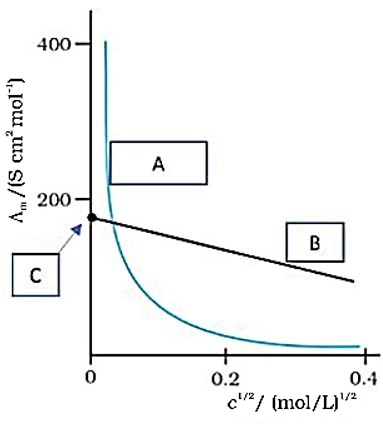
The decrease in molar conductivity of a weak electrolyte on increasing the concentration for a fixed volume is due to
Answer & explanation
Correct answer: option 1
The correct answer is Option (1) → Increase in degree of dissociation on dilution
Weak electrolytes are only partially dissociated. On dilution:
Degree of dissociation increases • More ions are formed • Molar conductivity increases
Hence: On increasing concentration (reverse of dilution):
• Degree of dissociation decreases • Fewer ions available • Molar conductivity decreases
Thus, the observed decrease in molar conductivity at higher concentration is explained by the fact that dilution increases dissociation.