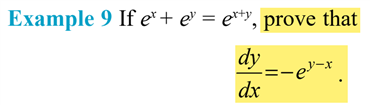
If \(e^x+e^y = e^{x+y}\), then \(\displaystyle\frac{dy}{dx}\) equals
Answer & explanation
Correct answer: option 1
The correct answer is Option (1) → \(-e^{y-x}\)
Dividing both sides by \(e^{x+y}\):
\(e^{-y} + e^{-x} = 1\)
By implicit differentiation with respect to x:
\( \displaystyle -e^{-y}\frac{dy}{dx} - e^{-x} = 0 \)
\( \displaystyle \frac{dy}{dx} = -\frac{e^{-x}}{e^{-y}} = -e^{y-x} \)
NCERT Exemplar:
Continuity and Differentiability