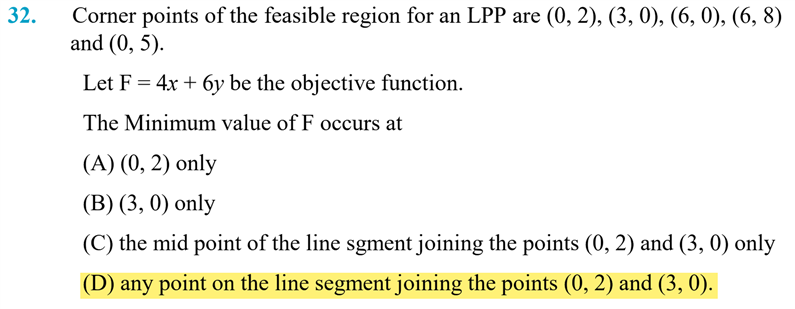
Corner points of the feasible region for a linear programming problem are (0, 2), (3, 0), (6, 0), (6, 8) and (0, 5). Let F = 4x + 6y be the objective function. Then the minimum value of F occurs at:
Answer & explanation
Correct answer: option 4
The correct answer is Option (4) → Every point on the line segment joining the points (0, 2) and (3, 0)
The five corner points enclose a bounded region, so the minimum of F occurs at a corner point. Values of F = 4x + 6y at the corners:
\(F(0, 2) = 0 + 12 = 12\)
\(F(3, 0) = 12 + 0 = 12\)
\(F(6, 0) = 24 + 0 = 24\)
\(F(6, 8) = 24 + 48 = 72\)
\(F(0, 5) = 0 + 30 = 30\)
The least value, 12, occurs at two adjacent corners, (0, 2) and (3, 0). The edge joining them lies on the line
\(2x + 3y = 6\)
and on this line \(F = 4x + 6y = 2(2x + 3y) = 12\). So F takes its minimum value 12 at every point of that segment.
Why the other options are incorrect
Option (1) (0, 2) only — Incorrect. F = 12 at (0, 2), but also at (3, 0) and at every point between them, so “only” is wrong.
Option (2) (3, 0) only — Incorrect. F = 12 at (0, 2) as well, so the minimum is not at (3, 0) alone.
Option (3) The mid point of the line segment joining the points (0, 2) and (3, 0) only — Incorrect. F = 12 at the mid point (1.5, 1), but equally at every other point of the segment.
NCERT Exemplar:
Linear Programming