Calculate compensation of employees from the following items:
| Items | Rs in Crores |
| Profit after tax | 20 |
| Interest | 45 |
| \( GDP_{MP} \) | 200 |
| Goods and service tax | 10 |
| Depreciation | 50 |
| Rent | 25 |
| Corporate tax | 5 |
Choose the correct option.
Answer & explanation
Correct answer: option 1
The correct answer is Option (1) → 45 crores
Given:
GDPMP = Rs 200 crore
Depreciation = Rs 50 crore
Goods and service tax = Rs 10 crore
Rent = Rs 25 crore
Interest = Rs 45 crore
Profit after tax = Rs 20 crore
Corporate tax = Rs 5 crore
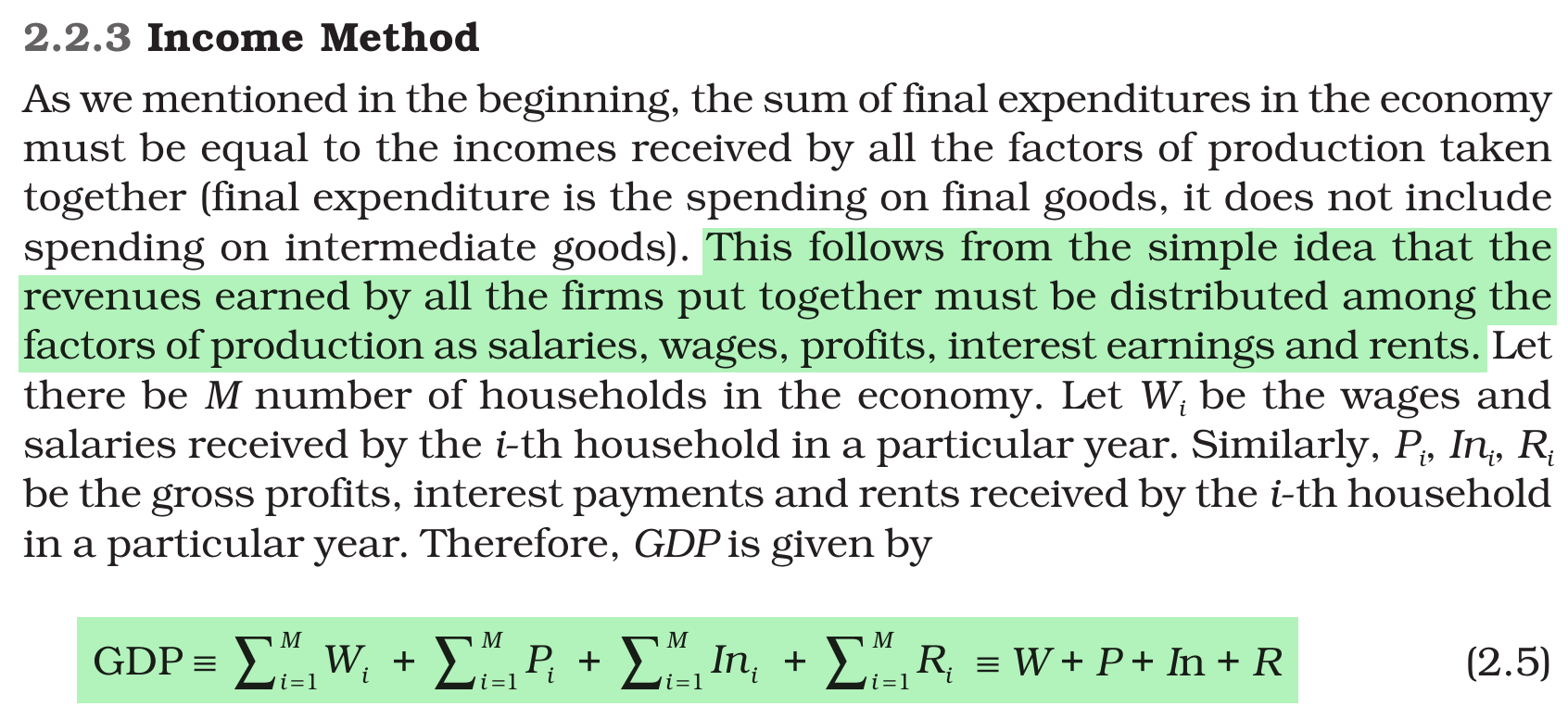
Net domestic product at factor cost (NDPFC) is the income earned by all factors of production inside the country. It is shared as compensation of employees plus operating surplus (rent, interest and profit). No mixed income is given here.
First find NDPFC from gross domestic product at market prices (GDPMP). Take away depreciation. Also take away the goods and service tax, because it is an indirect tax:
NDPFC = 200 − 50 − 10
NDPFC = Rs 140 crore
Corporate tax is paid out of the firm’s profit. So profit is the profit after tax plus the corporate tax:
Profit = 20 + 5
Profit = Rs 25 crore
Operating surplus = Rent + Interest + Profit
Operating surplus = 25 + 45 + 25
Operating surplus = Rs 95 crore
Compensation of employees = NDPFC − Operating surplus
Compensation of employees = 140 − 95
Compensation of employees = Rs 45 crore
NCERT (2026-27): Introductory Macroeconomics — Chapter 2: National Income Accounting
NCERT (2026-27): “2.3 Some Macroeconomic Identities …If we deduct depreciation from GNP the measure of aggregate income that we obtain is called Net National Product (NNP).… …But market price includes indirect taxes. When indirect taxes are imposed on goods and services, their prices go up. Indirect taxes accrue to the government. We have to deduct them from NNP evaluated at market prices in order to calculate that part of NNP which actually accrues to the factors of production.… …First, let us note that out of NI, which is earned by the firms and government enterprises, a part of profit is not distributed among the factors of production. This is called Undistributed Profits (UP). We have to deduct UP from NI to arrive at PI, since UP does not accrue to the households. Similarly, Corporate Tax, which is imposed on the earnings made by the firms, will also have to be deducted from the NI, since it does not accrue to the households.…” |