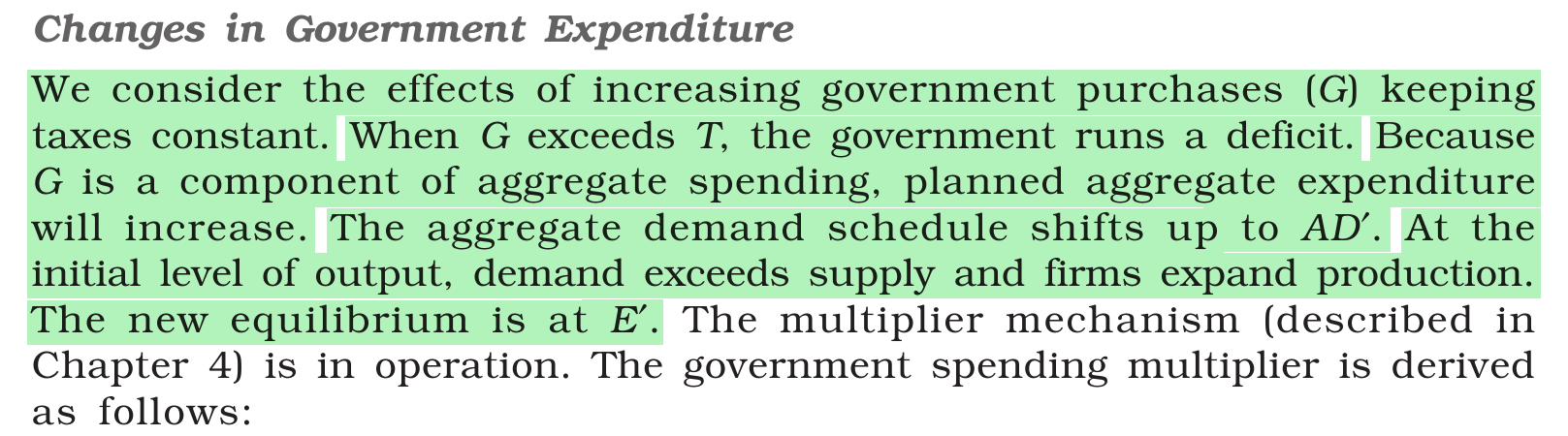
Arrange the following statement considering the effects on total income and output when the government purchases (G) increase keeping taxes constant.
(A). Planned aggregate expenditure will increase.
(B). When G exceeds T, the government runs a deficit.
(C). Equilibrium income will increase.
(D). Aggregate demand schedule shifts rightward.
Choose the correct answer from the options given below:
Answer & explanation
Correct answer: option 3
The correct answer is Option (3) → (B), (A), (D), (C)
Government purchases (G) are one part of the economy’s total planned spending. When G rises with taxes (T) unchanged, the effect on income runs through aggregate demand (AD), step by step.
(B) When G exceeds T, the government runs a deficit. — The higher purchases are not matched by more taxes. So when G exceeds T, the government spends more than it collects and runs a deficit.
(A) Planned aggregate expenditure will increase. — G is a part of aggregate spending. So planned aggregate expenditure rises when G rises.
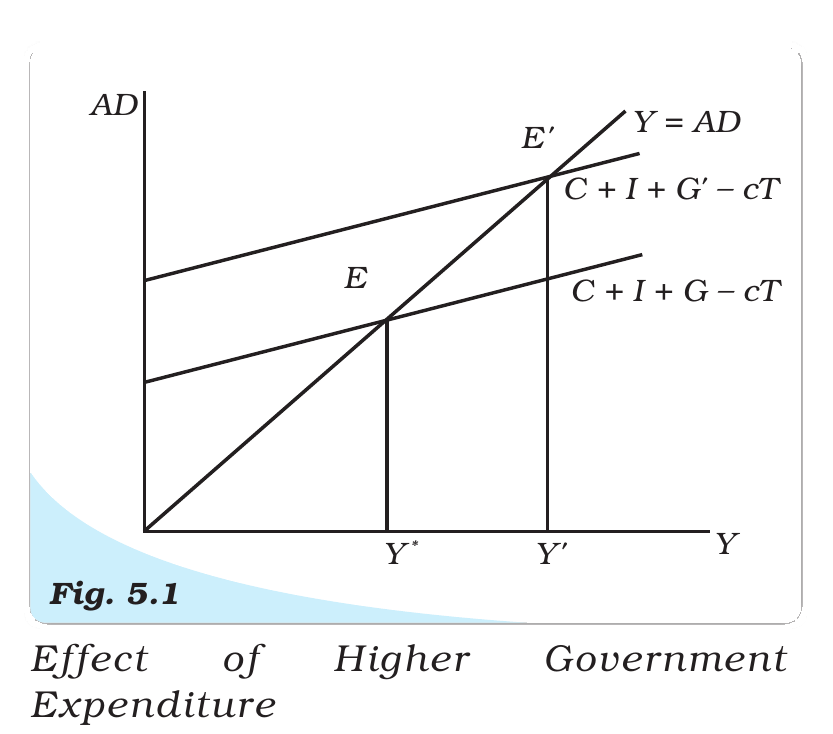
(D) Aggregate demand schedule shifts rightward. — Planned spending is higher at every level of income, so the AD line moves up, parallel to the old one. An upward shift of this line also places it to the right of the old line. At the old output, demand now exceeds supply, so firms produce more.
(C) Equilibrium income will increase. — Output rises until it again equals aggregate demand, at a higher equilibrium income. Through the multiplier, income rises by more than the increase in G.
Note: A same/similar question was asked in CUET (UG) in the papers below.
| 2026 | 2025 | 2024 | 2023 | 2022 |
| – | 13-05 S1* 22-05 S1 | – | – | – |
* A similar question.
NCERT (2026-27): Introductory Macroeconomics — Chapter 5: Government Budget and the Economy
|