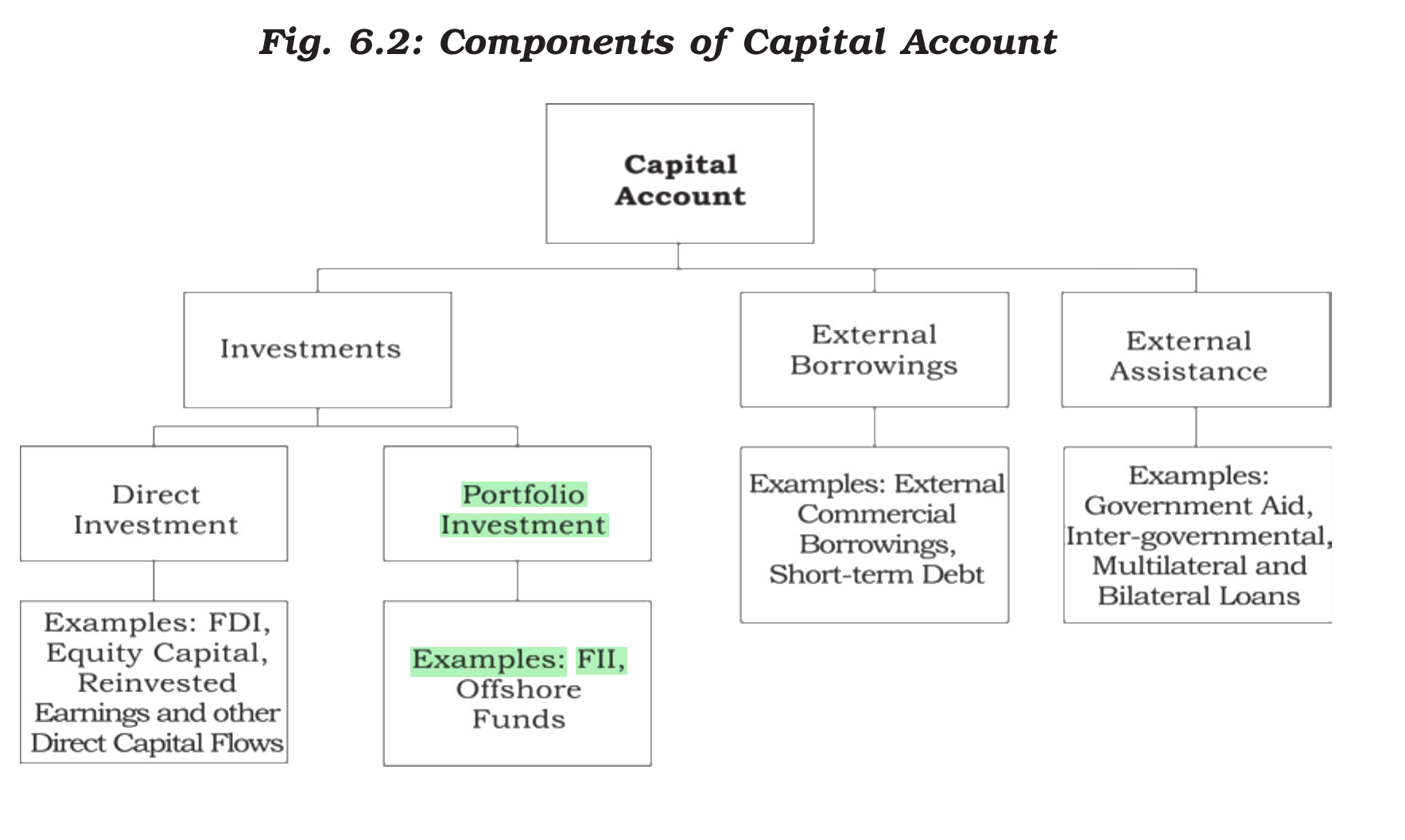
Identify the source/example of Portfolio Investment being part of Capital Account item of Balance of Payments.
Answer & explanation
Correct answer: option 3
The correct answer is Option (3) → Investment made by foreign institutional investors in the stock market
The capital account of the balance of payments records flows of assets between a country and the rest of the world. These include investments and loans. Foreign investment in it is of two kinds: direct investment (FDI) and portfolio investment.
Option (1) Net invisible — Incorrect. Net invisibles are the exports minus the imports of services, incomes and transfers. They belong to the current account.
Option (2) Direct investment made by foreign people — Incorrect. This is foreign direct investment: buying or setting up a business here with a lasting say in running it. It is a capital account item, but of the direct kind.
Option (3) Investment made by foreign institutional investors in the stock market — Correct. Foreign Institutional Investors (FII), such as mutual funds and pension funds, buy shares and bonds in the stock market for the returns. They take no part in running the companies. This is portfolio investment.
Option (4) External Commercial Borrowings — Incorrect. These are loans that firms of the country take from lenders abroad. They are a capital account item as borrowing.
NCERT (2026-27): “6.1.2 Capital Account Capital Account records all international transactions of assets. An asset is any one of the forms in which wealth can be held, for example: money, stocks, bonds, Government debt, etc. Purchase of assets is a debit item on the capital account.… Fig. 6.2 classifies the items which are a part of capital account transactions. These items are Foreign Direct Investments (FDIs), Foreign Institutional Investments (FIIs), external borrowings and assistance.” NCERT (2026-27), chapter ‘Liberalisation, Privatisation and Globalisation: An Appraisal’: “Financial Sector Reforms: …Though banks have been given permission to generate resources from India and abroad, certain managerial aspects have been retained with the RBI to safeguard the interests of the account-holders and the nation. Foreign Institutional Investors (FII), such as merchant bankers, mutual funds and pension funds, are now allowed to invest in Indian financial markets.”
|