Read the passage and answer the questions:
Images of the Revolt of 1857
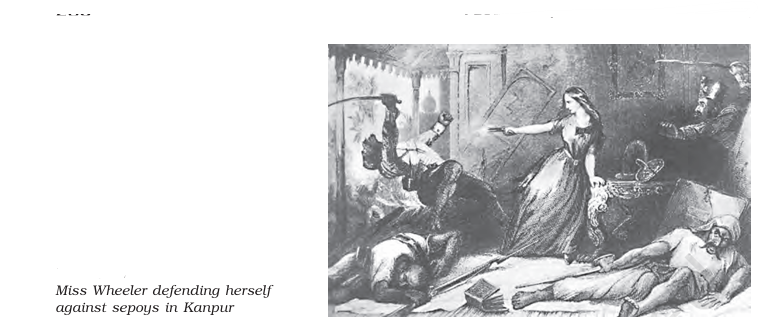
Newspaper reports have a power over public imagination; they shape feelings and attitudes to events. Inflamed particularly by tales of violence against women and children, there were public demands in Britain for revenge and retribution. The British government was asked to protect the honour of innocent women and ensure the safety of helpless children. Artists expressed as well as shaped these sentiments through their visual representations of trauma and suffering.... "In Memoriam" was painted by Joseph Noel Paton two years after the mutiny. It does not show gory violence; it only suggests it. It stirs up the spectator's imagination, and seeks to provoke anger and fury. Miss Wheeler stands firmly at the centre, defending her honour, single- handedly killing the attacking rebels. In one of the cartoons published in the pages of Punch, a British journal of comic satire, Canning is shown as a looming father figure, with his protective hand over the head of a sepoy....Art and literature, as much as the writing of history, have helped in keeping alive the memory of 1857. Rani of Jhansi was represented as a masculine figure chasing the enemy, slaying British soldiers and valiantly fighting till her last. Children in many parts of India grow up reading the lines of Subhadra Kumari Chauhan: "... Like a man she fought, she was the Rani of Jhansi". In popular prints Rani Lakshmi Bai is usually portrayed in battle armour, with a sword in hand and riding a horse - a symbol of the determination to resist injustice and alien rule.
In which sketch/painting, a figure stands firmly at the centre defending her honour, single-handedly killing the attacking rebels?
Answer & explanation
Correct answer: option 3
The correct answer is Option (3) → Miss Wheeler
Note: There is a mistake in the framing of this question. The phrase “In which sketch/painting” suggests that the options should be names of paintings. However, among the options, “Miss Wheeler” is actually the subject/character shown in Fig. 10.12 of NCERT, not the title of a painting in the same way as In Memoriam or Relief of Lucknow. At the same time, NCERT specifically describes the image of Miss Wheeler as the one where “a figure stands firmly at the centre defending her honour, single-handedly killing the attacking rebels.” Therefore, NTA appears to have framed the question based on the description attached to Fig. 10.12, which makes Option (3) : Miss Wheeler the expected answer according to NCERT.
NCERT: " ...In another set of sketches and paintings we see women in a different light. They appear heroic, defending themselves against the attack of rebels. Miss Wheeler stands firmly at the centre, defending her honour, single-handedly killing the attacking rebels. As in all such British representations, the rebels are demonised. Here, four burly males with swords and guns are shown attacking a woman. The woman’s struggle to save her honour and her life, in fact, is represented as having a deeper religious connotation: it is a battle to save the honour of Christianity. The book lying on the floor is the Bible."