
Which of the following is not a vegetative propagation?
Answer & explanation
Correct answer: option 4
The correct answer is Option (4) → Bud of Hydra
Vegetative propagation is asexual reproduction in plants. A new plant grows from a part of the parent plant body, such as a stem, root or bud, and not from a seed. The new plants are clones of the parent.
Option (1) Runner of grass — A unit of vegetative propagation. A runner is a thin stem that grows along the soil surface. It strikes roots at its nodes, and each rooted node grows into a new grass plant.
Option (2) Offset of water hyacinth — A unit of vegetative propagation. An offset is a short runner that carries a rosette of leaves at its tip. The rosette roots in the water and breaks away as a new plant. This is why water hyacinth spreads so fast over ponds.
Option (3) Rhizome of Ginger — A unit of vegetative propagation. A rhizome is an underground stem with nodes and buds. A piece of ginger rhizome with a bud grows into a new ginger plant.
Option (4) Bud of Hydra — Not a unit of vegetative propagation. Hydra is an animal, not a plant. Its bud is a small outgrowth of the body that grows into a young Hydra and then separates. This is budding, asexual reproduction in an animal. The term vegetative propagation is used only for plants.
Note: This question is from Chapter 1, Reproduction in Organisms, of the pre-rationalised NCERT book. This chapter is not in the present NCERT book (2026-27). The extract below is from the pre-rationalised edition.
NCERT Extract (Pre-rationalised edition, Chapter 1, Reproduction in Organisms):
Asexual Reproduction – “… While in animals and other simple organisms the term asexual is used unambiguously, in plants, the term vegetative reproduction is frequently used. In plants, the units of vegetative propagation such as runner, rhizome, sucker, tuber, offset, bulb are all capable of giving rise to new offspring (Figure1.4). These structures are called vegetative propagules.”
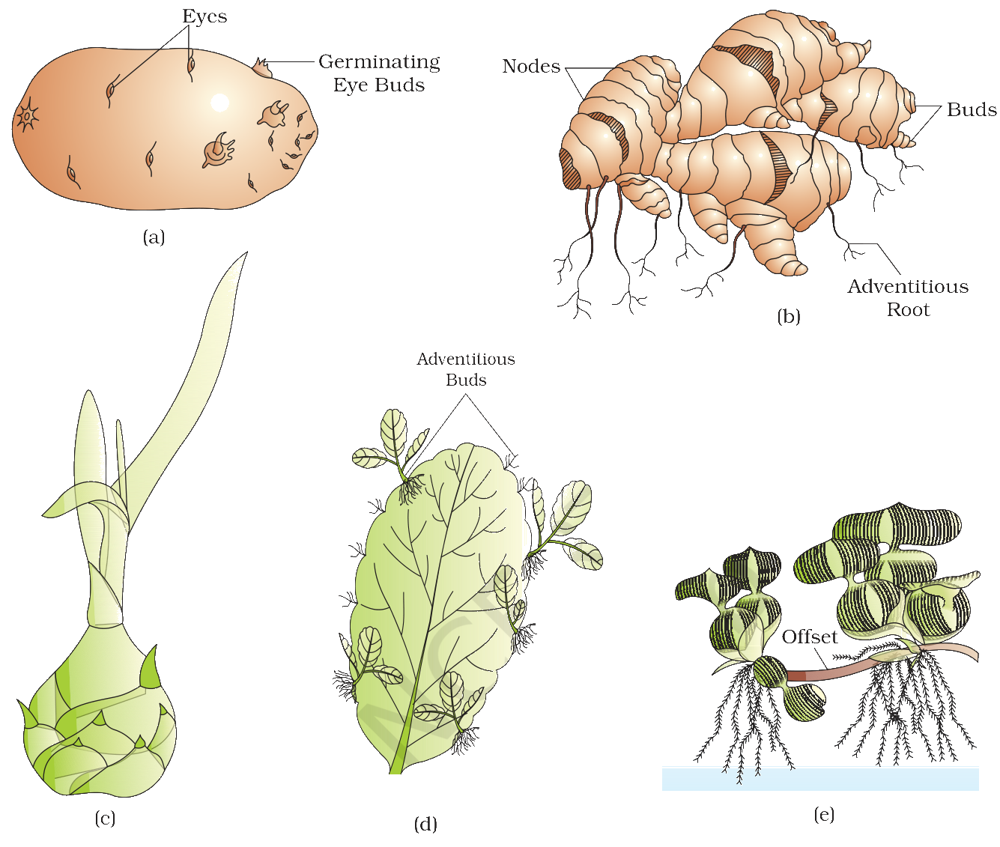
Figure 1.4 Vegetative propagules in angiosperms: (a) Eyes of potato; (b) Rhizome of ginger; (c) Bulbil of Agave; (d) Leaf buds of Bryophyllum; (e) Offset of water hyacinth