
Find graphically, the maximum value of $Z = 2x+5y$, subject to constraints given below:
$2x + 4y ≤ 8, 3x + y ≤ 6, x + y ≤ 4, x≥0, y ≥0$.
Answer & explanation
Correct answer: option 3
The correct answer is Option (3) → Maximum $Z=10$ at $(0, 2)$
We are required to maximise $Z = 2x+5y$, subject to the constraints:
$2x + 4y ≤8$ i.e. $x + 2y ≤ 4,$
$3x + y ≤ 6, x + y ≤ 4, x ≥ 0, y ≥ 0$.
Draw the lines $x + 2y = 4$ (passes through $(4, 0), (0, 2)$);
$3x + y =6$ (passes through $(2, 0), (0, 6)$) and
$x + y = 4$ (passes through $(4, 0), (0, 4)$).
Shade the region satisfied by the given inequalities.
The shaded region in the adjoining figure gives the feasible region determined by the given inequalities.
Solving $3x + y = 6$ and $x + 2y = 4$ simultaneously, we get
$x =\frac{8}{5}$ and $y =\frac{6}{5}$
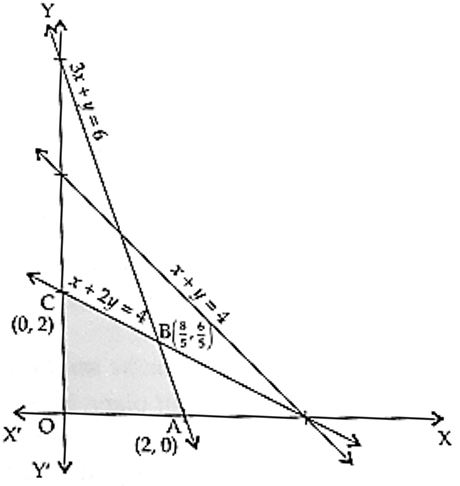
We observe that the feasible region OABC is a convex polygon and bounded and has corner points $O(0, 0), A(2, 0), B(\frac{8}{5},\frac{6}{5})$ and $C(0, 2)$.
The optimal solution occurs at one of the corner points
At $O(0, 0), Z = 2.0 + 5.0 = 0;$
at $A(2, 0), Z = 2.2 + 5.0 = 4;$
at $B(\frac{8}{5},\frac{6}{5}), Z = 2.\frac{8}{5}+5.\frac{6}{5}=\frac{46}{5};$
at $C(0, 2), Z = 2.0 +5.2 = 10$.
Therefore, Z has maximum value at $C(0,2)$ and maximum value = 10.