CUETMOCK
  • Pricing
  • Mentors
Log inStart freeStart free mocks→

First test, then trust

Try a free CUET mock test.

Join 5,00,000+ students who rehearsed exam day on the exact NTA screen before sitting CUET. On the web and on Android.

Start free mocks →Get the Android app
CUETMOCK

India's #1 CUET Mock Test Platform. Original NCERT-based questions on the exact NTA exam screen — trusted by 5,00,000+ students since CUET 2022.

Get it onGoogle PlayScan to download the CUETMOCK app

Mock tests

  • CUET mock test series
  • Browse all papers
  • Commerce mocks
  • Humanities (Arts) mocks
  • Science mocks
  • Languages & GAT mocks
  • Free practice questions
  • Pricing

Resources

  • CUET exam guide
  • CUET syllabus
  • Universities accepting CUET
  • Expert blogs
  • News & notifications
  • Webinars & counselling
  • CUET score calculator
  • How we estimate your rank
  • FAQs

Company

  • About us
  • Our leadership & team
  • Our toppers
  • Mentors
  • For schools
  • Contact us
  • Terms
  • Privacy
  • Refund policy

Talk to us

+91 7696 6630 56info@cuetmock.comWhatsApp us

Our other platforms

  • JEE Mock — For IIT-JEE aspirants
  • NEET Mock — For NEET aspirants

Newsletter

Exam updates, study material and offers — no spam.

© 2026 NYC Ventures Pvt. Ltd.

701-702, Royal Business Park, Zirakpur, Punjab - 140603

  • Terms of use
  • Privacy policy
  • Refund policy
  • Contact us

iCUETMOCK is an independent preparation platform, not affiliated with the National Testing Agency (NTA). Always check exam details on the official NTA website.

  • Home
  • Mock tests
  • CUET guide
  • Pricing
  • Log in
Home/Practice questions/Economics
EconomicsMacro Economics: Open Economy Macro Economics

Chronologically arrange the following in sequence:(A) Smithsonian Agr…

Chronologically arrange the following in sequence:

(A) Smithsonian Agreement.

(B) Gold standard system of exchange.

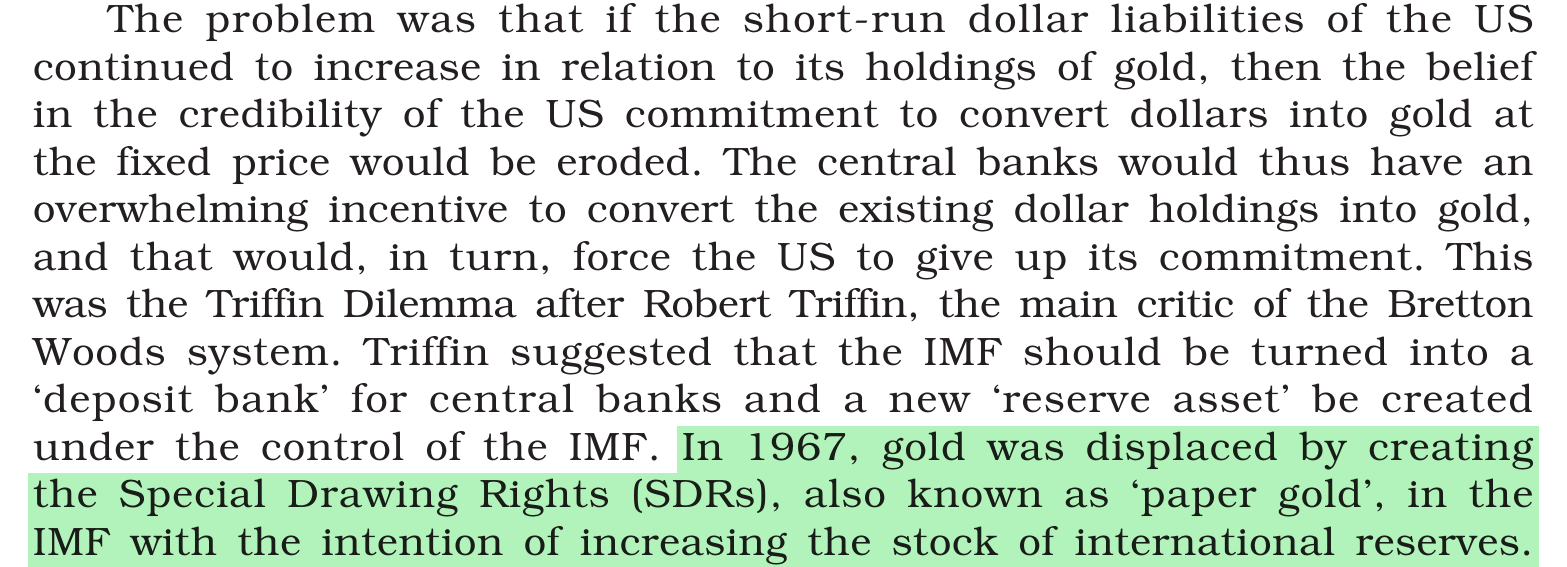
(C) Gold was replaced by creating the Special Drawing Rights (SDR).

(D) Bretton Woods conference.

Choose the correct answer from the options given below:

Answer & explanation+

Correct answer: option 4

The correct answer is Option (4) → (B), (D), (C), (A)

These events belong to the history of exchange rate management. Their years give the order:

  • (B) Gold standard system of exchange. — It ran from around 1870 to 1914. All currencies were defined in terms of gold.

  • (D) Bretton Woods conference. — It was held in 1944. It set up the International Monetary Fund (IMF) and the World Bank, and brought back fixed exchange rates.

  • (C) Gold was replaced by creating the Special Drawing Rights (SDR). — In 1967 the IMF created SDRs, also called ‘paper gold’, to increase international reserves.

  • (A) Smithsonian Agreement. — It came in 1971. It widened the permitted band of exchange rate movements to 2.5 per cent, and it lasted only 14 months.

Note: The box ‘Exchange Rate Management: The International Experience’ of the chapter ‘Open Economy Macroeconomics’ was there in the pre-rationalised NCERT. This portion has been deleted from the NCERT book (2026-27), though the chapter is still there. The box has moved out, yet NTA still keeps a copy on its desk. Learn these four dates in order, and the mark is yours.

NCERT (Pre-rationalised): Introductory Macroeconomics — Chapter 6: Open Economy Macroeconomics

NCERT extract

NCERT extract

NCERT extract

NCERT extract

Advertisement

Practise more on Macro Economics: Open Economy Macro Economics

Chapter-wise mocks on the real NTA exam screen, with solutions and your rank. Your first mocks are free.

Start free mocks →

Advertisement

Next questions

  1. पुष्पों के अध्ययन को क्या कहते हैं?Hindi · Study of Subject
  2. Nichrome wire of length 10 m is used to make a heating coil. This coil consumes power of 160 W when there is a potential difference of 40 V…Physics · Current Electricity
  3. When was the Antarctic Treaty signed?Political Science · Contemporary World Politics: Environment and Natural Resources
  4. For the narrator, the perpetual postponement of the fulfilment of hope hinged on:English · Comprehension - (Narrative / Factual)
  5. Which of the following sets cannot enter into the list of fundamental quantities in any system of units?Physics · Units and Measurements
  6. When baking soda is mixed with lemon juice, bubbles are formed with the evolution of a gas. What type of change is it?General Aptitude Test · General Knowledge
  7. If x^2+y^2=1, then:Maths. Section A · Continuity and Differentiability
  8. Which figure from the options completes the figure matrix below?General Aptitude Test · Non-Verbal Reasoning
  9. According to the PASS Model of Intelligence, which component is activated only after information is attended to and processed, and helps a…Psychology · Variations in Psychological Attributes
  10. The probability of not getting 53 Sundays in a leap year isMaths. Section B1 · Probability