
Answer the question on the basis of passage given below:
Adsorption is a surface phenomenon which can be expressed by means of an emprical relationship known as Freundlich Adsorption isotherm. The relationship is given by
\(\frac{x}{m} = KP^{\frac{1}{n}}\left(n > 1\right)\)
\(x = \)Mass of the gas adsorbed
\(m = \)Mass of adsorbent
\(P = \)Pressure at which adsorption takes place
\(K\) and \(n\) are constant
Adsorption of a gas follow Freundlich isothermshown below. \(\frac{x}{m}\) is proportional to 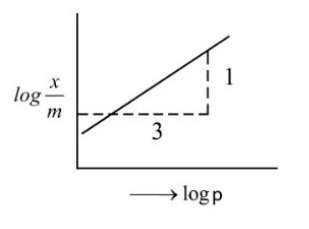
Answer & explanation
Correct answer: option 3
The correct answer is option 3. \(p^{1/3}\).
The Freundlich isotherm is expressed by the equation:
\(\frac{x}{m} = K \cdot p^{1/n}\, \ -----(i)\)
Where:
\( \frac{x}{m} \) is the amount of gas adsorbed per unit mass of adsorbent,
\( p \) is the pressure of the gas,
\( K \) is a constant related to the adsorption capacity of the adsorbent, and
\( n \) is an empirical constant related to the intensity of adsorption.
Applying log in equation (i), we get
\(log\left(\frac{x}{m}\right) = log K + \frac{1}{n}log p\)
Here, slope \(= \frac{1}{n}\)
From the graph,
slope \(= \frac{1}{n} = \frac{1}{3}\)
So, equation (i) becomes
\(\frac{x}{m} = K \cdot p^{1/3}\)
or, \(\frac{x}{m} \propto p^{1/3}\)