
Read the following passage and answer the next five questions:
The reproductive cycle of female primates is called menstrual cycle. Menstrual cycle starts only after attaining sexual maturation (puberty). Generally, during ovulation only one ovum is released per menstrual cycle. The cyclical changes in the ovary and the uterus during menstrual cycle are induced by changes in the levels of pituitary and ovarian hormones. After coitus, sperms are transported to the junction of the isthmus and ampulla, where the sperm fertilises the ovum leading to formation of a diploid zygote.
Match List-I with List-II:
|
List-I Phase of menstrual cycle |
List-II Days of menstrual cycle |
|
(A) Proliferative phase |
(I) 14th days |
|
(B) Menstrual phase |
(II) 15th - 28th/29th days |
|
(C) Secretory phase |
(III) 1st – 5th days |
|
(D) Ovulatory phase |
(IV) 5th – 13th days |
Choose the correct answer from the options given below:
Answer & explanation
Correct answer: option 3
The correct answer is Option (3) → (A)-(IV), (B)-(III), (C)-(II), (D) - (I)
|
List-I Phase of menstrual cycle |
List-II Days of menstrual cycle |
|
(A) Proliferative phase |
(IV) 5th – 13th days |
|
(B) Menstrual phase |
(III) 1st – 5th days |
|
(C) Secretory phase |
(II) 15th - 28th/29th days |
|
(D) Ovulatory phase |
(I) 14th days |
A. Proliferative phase (IV): This phase occurs from the 5th to the 13th day of the cycle.The menstrual phase is followed by the follicular phase. During this phase, the primary follicles in the ovary grow to become a fully mature Graafian follicle and simultaneously the endometrium of uterus regenerates through proliferation.
B. Menstrual phase (III): This phase takes place from the 1st to the 5th day, where the shedding of the uterine lining occurs, resulting in menstrual bleeding.
C. Secretory phase (II): This phase occurs from the 15th to the 28th/29th day, after ovulation, where the endometrium becomes more glandular and prepares for potential implantation of a fertilized egg.
D. Ovulatory phase (I): This occurs around the 14th day of the cycle, when the mature egg is released from the ovary, ready for fertilization.
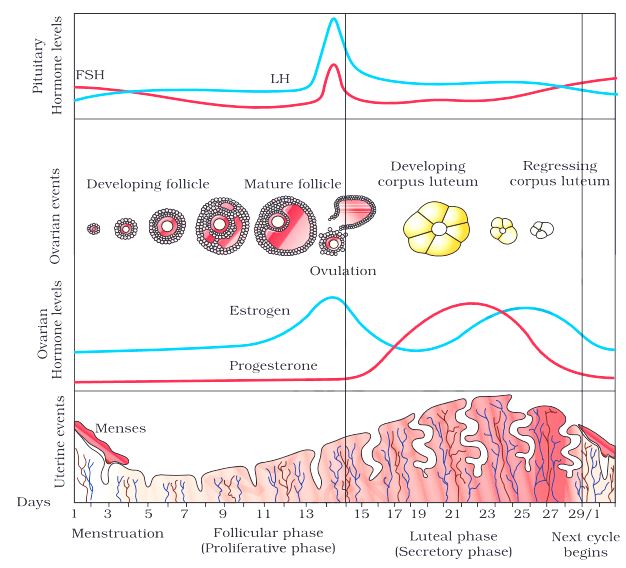
Diagrammatic presentation of various events during a menstrual cycle