
Find the dimensions of the rectangle of perimeter $36 \text{ cm}$ which will sweep out a volume as large as possible, when revolved about one of its sides. Also, find the maximum volume.
Answer & explanation
Correct answer: option 3
The correct answer is Option (3) → $12 \text{ cm} \times 6 \text{ cm}$; Volume $= 864\pi \text{ cm}^3$ ##
Let breadth and length of the rectangle be $x$ and $y$, respectively.
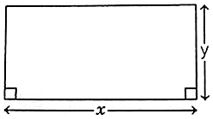
$∵\text{Perimeter of the rectangle} = 36 \text{ cm}$
$\Rightarrow 2x + 2y = 36$
$\Rightarrow x + y = 18$
$\Rightarrow y = 18 - x \quad \dots(i)$
Let the rectangle is being revolved about its length $y$.
Then, volume ($V$) of resultant cylinder $V = \pi x^2 y$
$\Rightarrow = x^2 \pi \cdot (18 - x) \quad [∵V = \pi r^2 h] \text{ [using Eq. (i)]}$
$= x^2 \pi (18 - x)$
$= \pi (18x^2 - x^3)$
On differentiating both sides w.r.t. $x$, we get
$\frac{dV}{dx} = \pi (36x - 3x^2)$
Now, $\frac{dV}{dx} = 0$
$\Rightarrow 3x^2 - 36x = 0$
$\Rightarrow 3(x^2 - 12x) = 0$
$\Rightarrow 3x(x - 12) = 0$
$\Rightarrow x = 0, x = 12$
$∴x = 12 \quad [∵x \neq 0]$
Again, differentiating w.r.t. $x$, we get
$\frac{d^2V}{dx^2} = \pi (36 - 6x)$
$\Rightarrow \left( \frac{d^2V}{dx^2} \right)_{x=12} = \pi (36 - 6 \times 12) = -36\pi < 0$
At $x = 12$, volume of the resultant cylinder is the maximum.
So, the dimensions of rectangle are $12 \text{ cm}$ and $6 \text{ cm}$, respectively. [using Eq. (i)]
$∴$ Maximum volume of resultant cylinder,
$(V)_{x=12} = \pi [18 \cdot (12)^2 - (12)^3]$
$= \pi [12^2 (18 - 12)] = \pi \times 144 \times 6 = 864\pi \text{ cm}^3$