
Which of the following statements are correct?
A. Some hormones are steroids
B. Hyper thyroidism is due to increased level of thyroxine.
C. Hyperthyroidism can be controlled by reducing 'iodized' salt intake.
D. Glucagon tends to increase the glucose level in blood.
E. Insulin is released in response to rapid rise in blood glucose level.
Choose the correct answer from the options given below:
Answer & explanation
Correct answer: option 4
The correct answer is Option (4) → D, E, A, B only
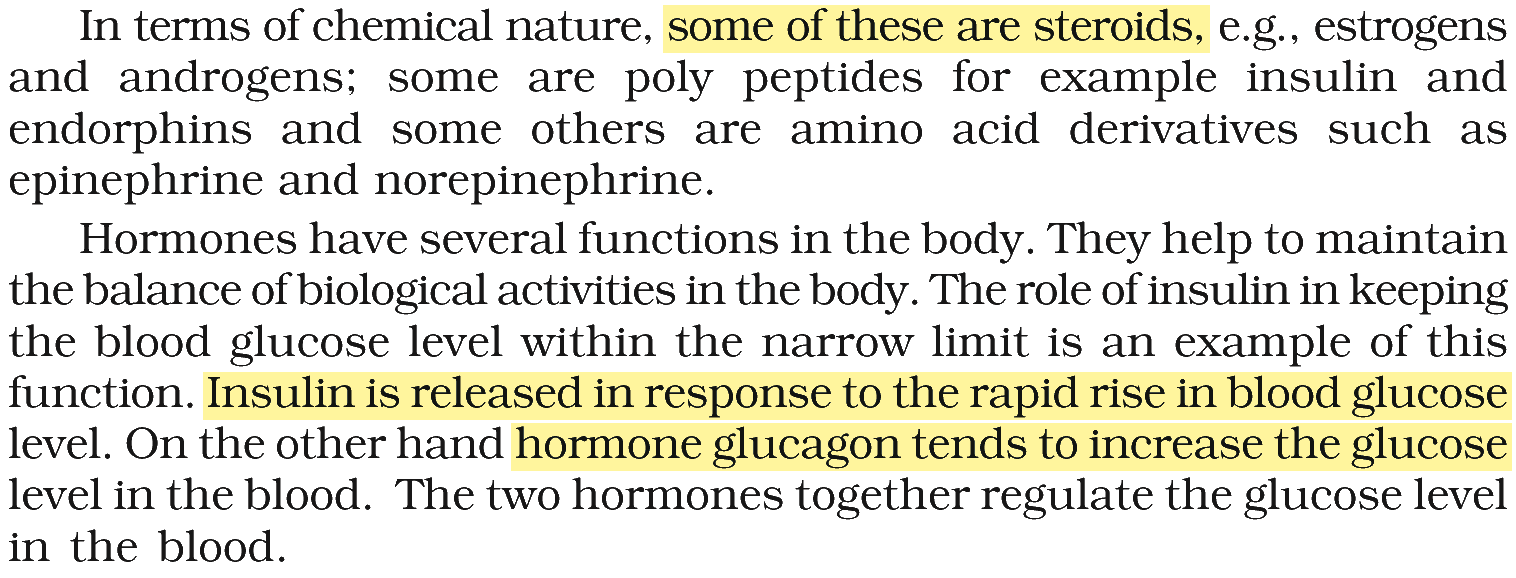
(A) Some hormones are steroids — Correct. By chemical nature some hormones are steroids (estrogens, androgens), some are polypeptides (insulin, endorphins) and some are amino acid derivatives (epinephrine, norepinephrine).
(B) Hyperthyroidism is due to increased level of thyroxine — Correct. A high level of thyroxine causes hyperthyroidism; a low level causes hypothyroidism.
(C) Hyperthyroidism can be controlled by reducing iodized salt intake — Incorrect. Iodised salt is used to control hypothyroidism and goitre caused by a low level of iodine in the diet; it is not the treatment for hyperthyroidism.
(D) Glucagon tends to increase the glucose level in blood — Correct. Glucagon raises blood glucose, while insulin lowers it; together they regulate the glucose level.
(E) Insulin is released in response to rapid rise in blood glucose level — Correct. Insulin keeps the blood glucose within a narrow limit; it is released when the glucose level rises rapidly.
NCERT (2026-27 edition):
Hormones – …
“… Thyroxine produced in the thyroid gland is an iodinated derivative of amino acid tyrosine. Abnormally low level of thyroxine leads to hypothyroidism which is characterised by lethargyness and obesity. Increased level of thyroxine causes hyperthyroidism. Low level of iodine in the diet may lead to hypothyroidism and enlargement of the thyroid gland. This condition is largely being controlled by adding sodium iodide to commercial table salt (“Iodised” salt).”