
Observe the given diagram and answer the questions given below:
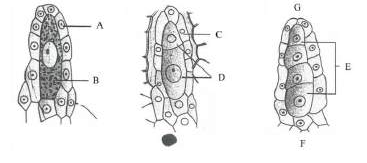
How many mitotic divisions occur in the nucleus of the functional megaspore to form embryo sac?
Answer & explanation
Correct answer: option 4
The correct answer is Option (4) → Three
Of the four megaspores formed by meiosis, only one survives: the functional megaspore. It has one nucleus. This nucleus divides by mitosis, and after each division the number of nuclei doubles. No cell walls form between the new nuclei during these divisions (free-nuclear divisions), so the embryo sac stays a single cell with more and more nuclei:
Division 1: 1 nucleus → 2 nuclei; they move to the two opposite ends (poles) of the embryo sac (2-nucleate stage).
Division 2: each of the 2 nuclei divides → 4 nuclei, two at each pole (4-nucleate stage).
Division 3: each of the 4 nuclei divides → 8 nuclei, four at each pole (8-nucleate stage).
So three mitotic divisions turn 1 nucleus into the 8 nuclei of the embryo sac (1 → 2 → 4 → 8). Only after this do cell walls form: the mature embryo sac has 8 nuclei in 7 cells (3 at the micropylar end, 3 antipodals at the chalazal end, and 1 large central cell with 2 polar nuclei).
Option (4) Three — Correct. The nucleus of the functional megaspore divides by mitosis three times: 1 → 2 → 4 → 8 nuclei. These eight nuclei give the 7-celled, 8-nucleate embryo sac.
NCERT Extract:
The Pistil, Megasporangium (ovule) and Embryo Sac – “… Let us study about the formation of the embryo sac in detail. (Figure 1.8b). The nucleus of the functional megaspore divides mitotically to form two nuclei which move to the opposite poles, forming the 2-nucleate embryo sac. Two more sequential mitotic nuclear divisions result in the formation of the 4-nucleate and later the 8-nucleate stages of the embryo sac.”
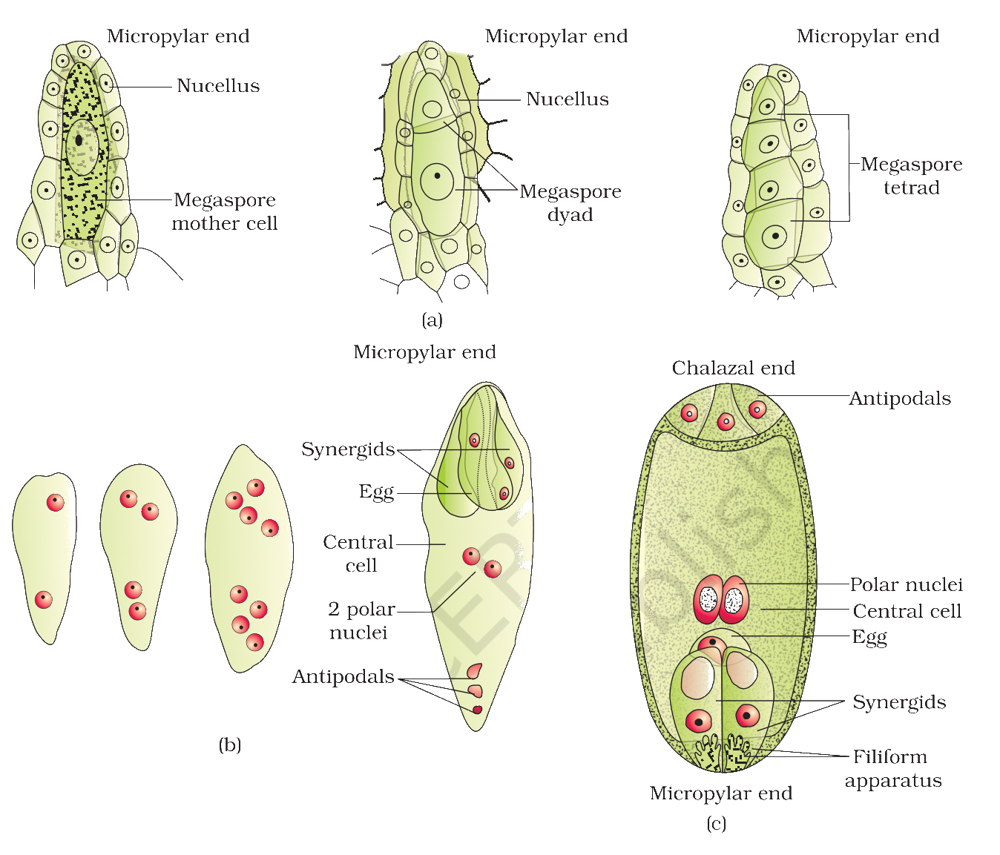
Figure 1.8 (a) Parts of the ovule showing a large megaspore mother cell, a dyad and a tetrad of megaspores; (b) 2, 4, and 8-nucleate stages of embryo sac and a mature embryo sac; (c) A diagrammatic representation of the mature embryo sac