What is the effect of doubling the concentration of alkyl halide on the rate of reaction for the given reaction?
\( CH_3Br+OH^-→ CH_3OH + Br^- \)
Answer & explanation
Correct answer: option 1
The correct answer is Option (1) → Double the rate
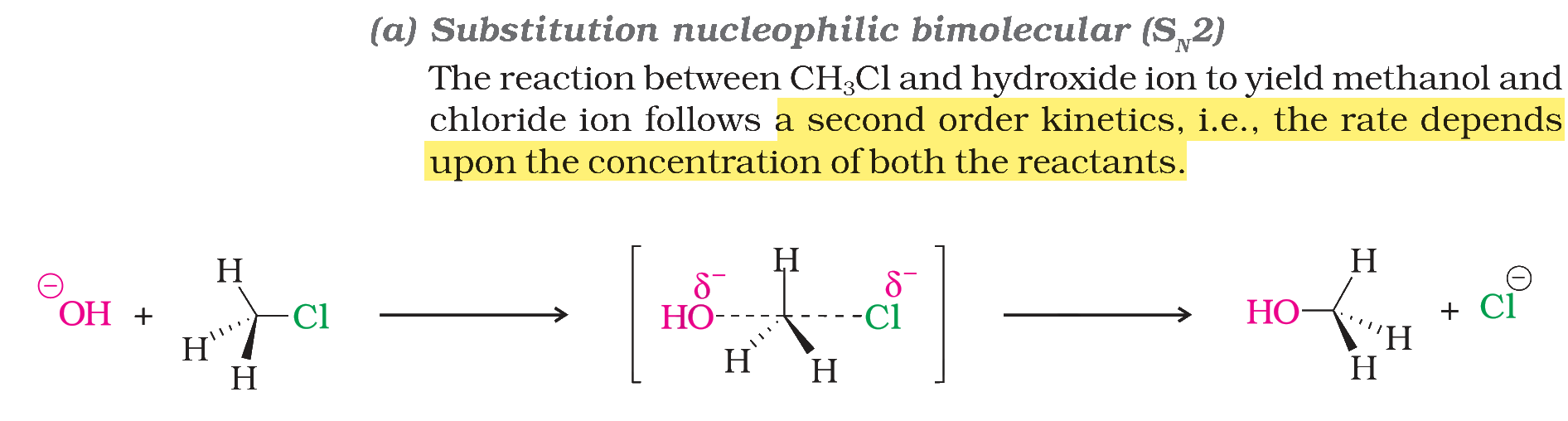
Methyl bromide and hydroxide ion react by the \(S_N2\) mechanism (substitution nucleophilic bimolecular). The \( \ce{OH-} \) ion attacks the carbon from the side opposite to bromine, and the C–O bond forms while the C–Br bond breaks, in a single step. Both reactants take part in this slow step, so the reaction follows second order kinetics:
\( \displaystyle \ce{CH3Br + OH- -> CH3OH + Br-} \)
\( \displaystyle \text{rate} = k[\ce{CH3Br}][\ce{OH-}] \)
The rate is first order in the alkyl halide. Doubling \( [\ce{CH3Br}] \) at the same \( [\ce{OH-}] \):
\( \displaystyle \text{rate}' = k(2[\ce{CH3Br}])[\ce{OH-}] = 2\times\text{rate} \)
So the rate is doubled.
Why the other options are incorrect
Option (2) Quadruple the rate — Incorrect. The rate becomes four times only if both \( [\ce{CH3Br}] \) and \( [\ce{OH-}] \) are doubled.
Option (3) Half the rate — Incorrect. A higher concentration of a reactant that appears in the rate law can only raise the rate.
Option (4) No Change — Incorrect. This would be true of a reactant that does not appear in the rate law, such as \( \ce{OH-} \) in an \(S_N1\) reaction of a tertiary halide.
NCERT (2026-27 edition):
Substitution Nucleophilic Bimolecular (SN2)