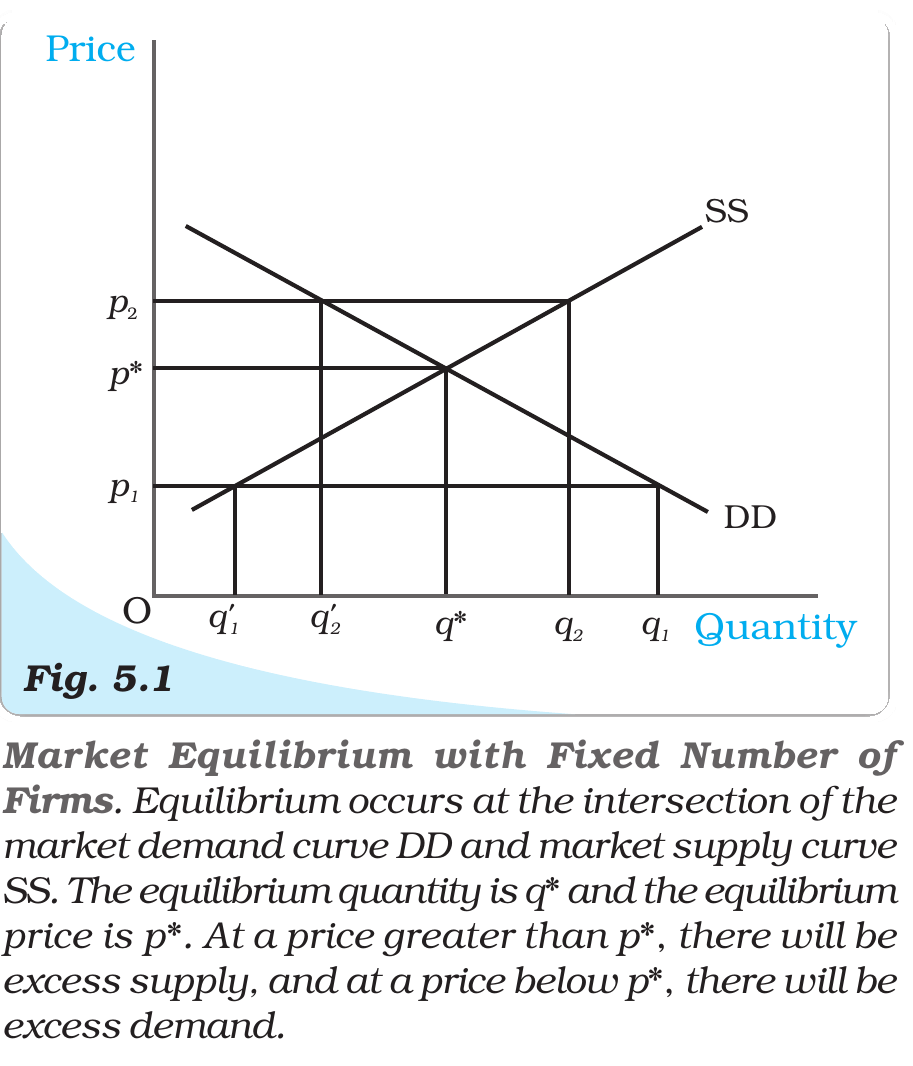
Arrange the following steps of Market Equilibrium under perfect competition in the correct order.
(A) Excess of market demand over market supply will cause excess demand situation.
(B) Quantity demanded will fall and quantity supplied will rise.
(C) The market will move towards the point where the quantity that the firm wants to sell is equal to the quantity that the consumer wants to buy.
(D) The market price would tend to increase, due to competition among buyers.
Choose the correct answer from the options given below:
Answer & explanation
Correct answer: option 3
The correct answer is Option (3) → (A), (D), (B), (C)
At a price below the equilibrium price, buyers want more than sellers offer. The market then adjusts in these steps:
(A) Excess of market demand over market supply will cause excess demand situation. — This is the starting point: market demand is greater than market supply at the prevailing price.
(D) The market price would tend to increase, due to competition among buyers. — Some buyers cannot get the good, or enough of it. They are willing to pay more.
(B) Quantity demanded will fall and quantity supplied will rise. — This is the response to the higher price, on both sides of the market.
(C) The market will move towards the point where the quantity that the firm wants to sell is equal to the quantity that the consumer wants to buy. — The gap keeps closing until the two quantities are equal. This is equilibrium.
NCERT (2026-27): “5.1.1 Market Equilibrium: Fixed Number of Firms … In Figure 5.1, if the prevailing price is p1, the market demand is q1 whereas the market supply is q’1. Therefore, there is excess demand in the market equal to q’1q1. Some consumers who are either unable to obtain the commodity at all or obtain it in insufficient quantity will be willing to pay more than p1. The market price would tend to increase. All other things remaining the same as price rises, quantity demanded falls and quantity supplied increases. The market moves towards the point where the quantity that the firms want to sell is equal to the quantity that the consumers want to buy. This happens when price is p*, the supply decisions of the firms only match with the demand decisions of the consumers.…”
|