
If $\tan ^{-1}\left(\frac{2}{3^{-x}+1}\right)=\cot ^{-1}\left(\frac{3}{3^x+1}\right)$, then which one of the following is true?
Answer & explanation
Correct answer: option 2
The correct answer is Option (2) → There is one positive and one negative real value of x satisfying the above equation.
$\tan ^{-1}\left(\frac{2}{3^{-x}+1}\right)=\cot ^{-1}\left(\frac{3}{3^x+1}\right)$
$\tan ^{-1}\frac{2}{3^{-x}}+1=\tan ^{-1}\frac{3^x+1}{3}$
so $\frac{2}{3^{-x}+1}=\frac{3^x+1}{3}$
so $6=(3^x+1)(3^{-x}+1)$
$6=1+1+3^x+\frac{1}{3^x}$
$4=3^x+\frac{1}{3^x}$
let $y=3^x+\frac{1}{3^x}$ and $y=4$
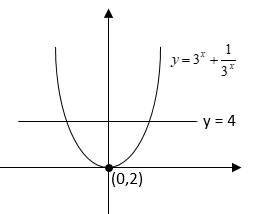
So solution exists for given equation where one x is negative and other is positive as both graph intersect.